

Future Rugged Computing Trends: 2026 Strategic Guide for OEMs

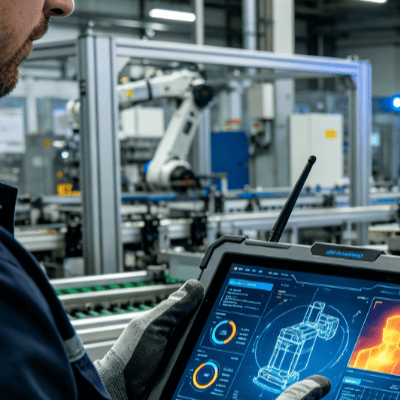
The landscape of industrial operations is no longer defined by simple durability. While “ruggedness” once meant a thick chassis and rubber bumpers, the shift toward Industry 5.0 and hyper-connected field operations has redefined the baseline. Today, the conversation among procurement managers and systems engineers has shifted from “Will it survive a drop?” to “Can it process neural networks at the edge while maintaining a 10-hour thermal envelope?”
As field environments become more data-intensive, the hardware supporting them must evolve beyond passive protection. Decision-makers are now balancing the traditional requirements of MIL-STD-810H compliance with the urgent need for high-speed data throughput and AI-driven diagnostics. Understanding these shifts is critical for any enterprise looking to lower its Total Cost of Ownership (TCO) and avoid hardware obsolescence within a 36-month cycle.
Edge AI Integration: Moving Intelligence to the Point of Action
One of the most significant rugged computing trends is the transition from cloud-dependent processing to Edge AI. In sectors like oil and gas or remote mining, waiting for cloud latency is not just an inefficiency; it is a safety risk.
Modern rugged tablets and laptops are increasingly equipped with dedicated Neural Processing Units (NPUs) or integrated GPUs capable of running complex machine-vision algorithms locally. This allows field technicians to perform real-time thermal imaging analysis, facial recognition for secure access, or predictive maintenance on heavy machinery without a constant satellite or cellular link. For an OEM project manager, selecting a platform that supports OpenVINO or similar AI frameworks is becoming a standard requirement for next-generation deployments.
Connectivity Evolution: The 5G and Wi-Fi 6E Standard
Connectivity is the lifeblood of modern field operations. We are seeing a decisive move away from 4G LTE toward 5G Sub-6GHz and Wi-Fi 6E. This isn’t just about speed; it is about “density” and “latency.”
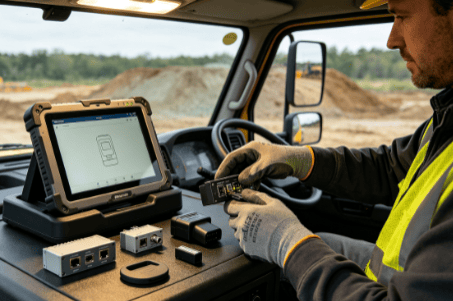
In a smart warehouse or a densely packed manufacturing floor, Wi-Fi 6E allows hundreds of rugged devices to operate simultaneously without signal interference. For outdoor utilities, 5G provides the low latency required for augmented reality (AR) overlays, where a technician can view “x-ray” underground piping layouts through a rugged tablet screen in real-time. When evaluating suppliers, the presence of multi-band GNSS and specialized antenna pass-throughs for vehicle docking stations is a key indicator of a future-proofed device.
Thermal Management in Fanless Architectures
Engineers face a constant battle: how to increase CPU performance while maintaining an IP65 or IP67 ingress protection rating. Historically, high performance required fans, which created a point of failure for dust and moisture.
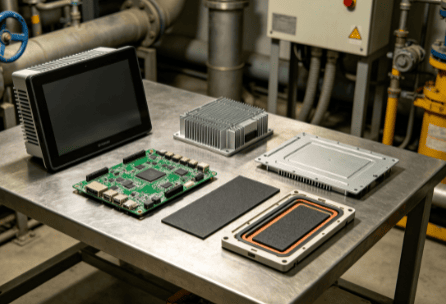
The trend is now leaning toward sophisticated passive cooling systems. Using vapor chambers, advanced graphite heat spreaders, and throttled power management, manufacturers are now achieving Core i7 performance in completely sealed, fanless enclosures. This significantly increases the MTBF (Mean Time Between Failure) in environments like flour mills, chemical plants, or desert construction sites where fine particulate matter would destroy a traditional cooled system.
Comparison: Legacy Rugged vs. Future-Ready Requirementsfgff
| Feature | Legacy Rugged (2020-2022) | Future-Ready Rugged (2025+) |
| Processor | Standard Mobile CPU | NPU-Optimized / AI-Ready |
| Connectivity | 4G LTE / Wi-Fi 5 | 5G / Wi-Fi 6E / CBRS Support |
| Display | 500-800 Nits (Standard) | 1000+ Nits / Optical Bonding |
| Security | Software Passwords | TPM 2.0 / Biometric / Smart Card |
| I/O Ports | Fixed Ports | Modular / User-Interchangeable |
| Sustainability | Replace Unit on Failure | Modular Repair / Long Lifecycle |
The Shift Toward Modular and Custom I/O
No two industrial applications are identical. A tablet used for police forensics requires different ports than one used for CNC machine diagnostics. We are seeing a move away from “one-size-fits-all” hardware toward modular I/O blocks.
This trend allows enterprises to swap out a DB9 Serial port for a RJ45 LAN port or a dedicated 1D/2D barcode scanner without replacing the entire fleet. For the B2B buyer, this modularity is a massive hedge against shifting project requirements. Platforms like Industrial-TabletPC focus heavily on this customization capability, providing the flexibility to integrate specialized sensors or legacy interfaces that standard consumer-grade hardware cannot accommodate.
Display Technology: Visibility Beyond High Brightness
In the past, making a screen “outdoor readable” simply meant cranking up the nits (brightness). However, high brightness drains battery life and generates heat. The current trend focuses on “Optical Bonding” and “Anti-Reflective (AR) Coatings.”
Optical bonding eliminates the air gap between the touch sensor and the LCD, reducing internal reflections and significantly improving contrast under direct sunlight. Furthermore, “Rain Mode” and “Glove Touch” sensitivity have evolved. Future-ready rugged devices use sophisticated firmware that can distinguish between a capacitive touch from a gloved finger and a “false touch” from a raindrop or salt spray, a critical distinction for maritime and emergency service applications.
Strategic Sourcing and OEM Considerations
For those managing large-scale deployments or OEM projects, the choice of a hardware partner is as critical as the hardware itself. The “commercial” reality of rugged computing is that the purchase price is only 20% of the lifecycle cost.
When evaluating the industrial-tabletpc.com portfolio or similar high-tier providers, buyers should focus on three manufacturing signals:
- Certification Longevity: Ensure the hardware maintains MIL-STD-810H and IP ratings throughout its 5-7 year expected life.
- Supply Chain Stability: In an era of chip shortages, look for partners who offer “Long-Life Cycle” components (typically 5+ years of availability).
- Customization Depth: Can the manufacturer modify the BIOS, add custom branding, or integrate specialized RF modules?
In high-volume manufacturing or critical infrastructure, the ability to source a consistent hardware “image” for five years is worth more than a lower upfront unit price.

FAQ
Q1: Why is MIL-STD-810H better than the older 810G for rugged tablets?
MIL-STD-810H is the latest revision of the US Department of Defense test standards. It includes more rigorous testing for shock, vibration, and temperature stress, specifically addressing the “multitest” environments where hardware faces multiple stressors (like heat and vibration) simultaneously.
Q2: Can Edge AI actually run on a rugged tablet without overheating?
Yes, but it requires specific hardware. Devices equipped with dedicated NPUs (like the Intel AI Boost or specialized ARM-based NPUs) can process AI workloads much more efficiently than a standard CPU, generating significantly less heat while maintaining higher throughput for tasks like object detection.
Q3: What is the typical lead time for customized industrial rugged tablets
For standard configurations, lead times are often 2–4 weeks. However, for OEM/ODM projects involving custom I/O, specialized mounting, or unique branding, lead times typically range from 8 to 14 weeks, depending on component availability and certification requirements.
Q4: Is 5G necessary for all rugged computing deployments?
Not necessarily. If your operation is confined to a facility with a strong Wi-Fi 6 infrastructure, 5G may be overkill. However, for field service, logistics, and “port-to-port” applications, 5G is essential for the bandwidth required to handle modern cloud-synced datasets.
Reference Source
- IEEE Xplore: https://www.ieee.org/
- Department of Defense: https://quicksearch.dla.mil/qsSearch.aspx
- Intel Industrial: Intel Industrial: https://www.intel.com/content/www/us/en/homepage.html
- ISO/IEC: https://www.iso.org/