

Top 10 Benefits of Rugged Tablet for Manufacturing Efficiency

The shift toward Industry 4.0 has transformed the factory floor from a place of manual labor into a data-driven ecosystem. Central to this evolution is the transition from paper-based tracking and stationary terminals to mobile, high-performance computing. However, a standard consumer-grade tablet rarely survives the vibrations, dust, and temperature fluctuations of a CNC machining center or an assembly line.
Integrating a rugged tablet for manufacturing is no longer just about hardware durability; it is a strategic move to ensure data integrity and operational continuity. For engineers and operations managers, the decision to deploy ruggedized mobile tech involves weighing specialized features against total cost of ownership (TCO).
Significant Reduction in Total Cost of Ownership (TCO)
While the initial procurement cost of a rugged tablet is higher than a consumer alternative, the long-term TCO is substantially lower. Consumer tablets in industrial environments typically face a failure rate of 30% or higher annually due to screen cracks, port failures, or internal component shifts.
Rugged tablets are engineered for a 5-to-7-year lifecycle. By adhering to MIL-STD-810G/H standards, these devices survive repeated drops onto concrete and constant vibration from heavy machinery. In manufacturing, every minute of device downtime equates to lost production cycles. Investing in specialized hardware mitigates the hidden costs of frequent replacements, IT reconfiguration, and lost labor hours.
Specialized Ingress Protection (IP) for Harsh Environments
Manufacturing environments are rarely “clean rooms.” Whether it is metal shavings in a fabrication shop or moisture in a food processing plant, particulates are the enemy of electronics.
A professional-grade rugged tablet for manufacturing features high IP ratings (such as IP65 or IP67).
- IP65: Protects against dust ingress and low-pressure water jets from any direction.
- IP67: Offers complete protection against dust and can withstand temporary immersion in water.
This level of protection ensures that internal circuitry remains untouched by oil mist, coolant spray, or fine dust, preventing the short-circuits common in non-industrial hardware.
Native Data Capture with Integrated Scanning
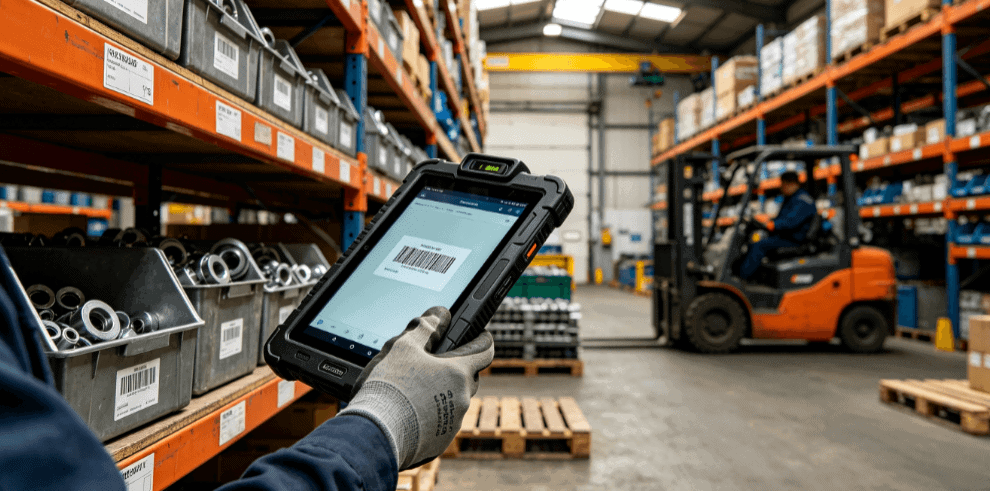
One of the most immediate benefits is the consolidation of tools. Instead of a worker carrying a tablet and a separate Bluetooth barcode scanner, rugged tablets often feature integrated 1D/2D imaging engines.
For inventory management and line-side replenishment, these scanners provide:
- Rapid SKU tracking: Instant scanning of components for assembly.
- Precision in Low Light: Industrial scanners outperform camera-based apps in dim warehouse corners.
- Durability: Unlike external peripherals that can be dropped or lost, an integrated scanner is part of the tablet’s reinforced chassis.
Seamless Integration with MES and ERP Systems
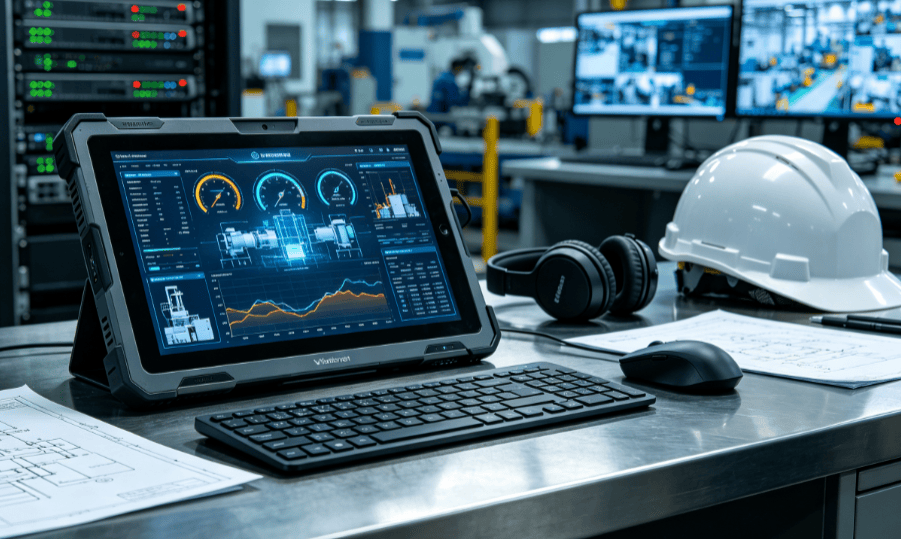
Modern manufacturing relies on Real-Time Location Systems (RTLS) and Manufacturing Execution Systems (MES). A rugged tablet serves as the primary interface for operators to interact with SAP, Oracle, or custom SQL databases.
With options for both Windows 10/11 Pro and Android Enterprise, these tablets allow IT departments to deploy the same security protocols and software versions used on desktop workstations. This ensures that the data logged on the shop floor—such as scrap rates or cycle times—is synchronized instantly with the plant’s central management software.
Enhanced Connectivity in Shielded Environments
Factories are often “dead zones” for standard consumer WiFi due to metal structures and electromagnetic interference (EMI). Industrial tablets are equipped with high-gain antennas and support for:
- Dual-Band WiFi 6: For high-density connectivity.
- 4G/5G LTE: Essential for large-scale outdoor yards or facilities where WiFi infrastructure is incomplete.
- Dedicated GPS: For tracking large assets in expansive manufacturing complexes.
Sunlight-Readable and Glove-Touch Displays
Standard tablets become unreadable under high-intensity factory lighting or near large windows. Industrial rugged tablets utilize high-nit brightness (often 500–1000 nits) and optical bonding technology to reduce glare and maximize contrast.
Furthermore, the capacitive touchscreens are calibrated for “Glove Touch” and “Wet Touch” modes. In environments where PPE is mandatory, workers can update digital checklists or sign off on work orders without removing their safety gloves, maintaining both productivity and safety compliance.
Superior Battery Management and Hot-Swapping
Manufacturing operates on shifts, and a tablet that needs to sit in a charger for three hours is a liability. Rugged tablets address this through:
- High-Capacity Batteries: Often lasting 8 to 10 hours of continuous use.
- Hot-Swappable Technology: A small internal bridge battery keeps the device running for 30–60 seconds, allowing the operator to swap a depleted battery for a fresh one without shutting down applications or losing unsaved data.
Expansion Ports and Legacy Interface Support
Unlike consumer tablets that offer a single USB-C port, a rugged tablet for manufacturing is designed with industrial I/O in mind. It is common to find:
- RS232 Serial Ports (DB9): For direct communication with legacy PLC (Programmable Logic Controller) systems.
- RJ45 Ethernet Ports: For secure, wired diagnostics when wireless is unavailable.
- Customizable POGO Pins: For secure docking in forklifts or wall-mounted charging stations.
Improved Workforce Ergonomics and Mobility
Efficiency on the shop floor is often measured in “waste of motion.” By providing workers with lightweight yet durable tablets, you bring the workstation to the machine.
- Hand Straps & Briefcase Handles: Reduce fatigue during long shifts.
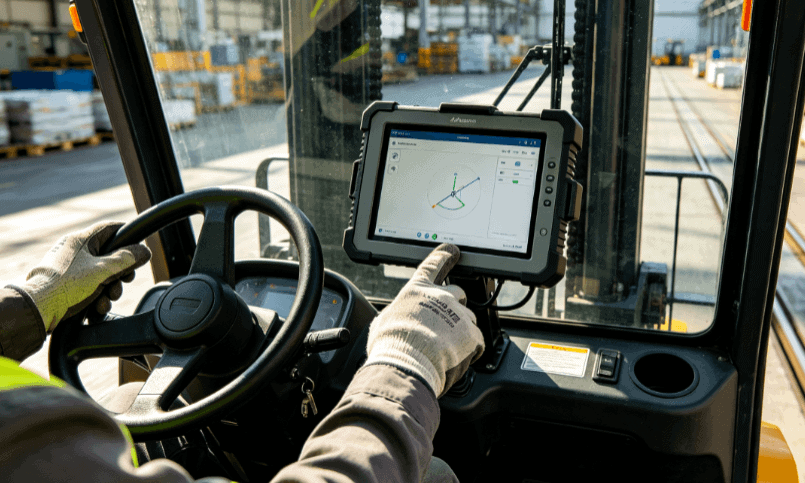
- Vehicle Mounts: Rugged tablets can be securely docked on forklifts or AGVs (Automated Guided Vehicles), transforming them into mobile telematics hubs.
Security and Compliance Support
In an era of increasing industrial espionage and cyber threats, rugged tablets provide enterprise-grade security. Features like TPM 2.0 (Trusted Platform Module), integrated fingerprint scanners, and Smart Card readers (CAC/PIV) ensure that only authorized personnel can access sensitive intellectual property or change machine parameters. This is critical for manufacturers working in aerospace, defense, or medical sectors where regulatory compliance is non-negotiable.
Selecting the Right Hardware Strategy
When evaluating hardware for your facility, consider the specific environmental stressors of your production line. For instance, the Rugged Tablets provided by Industrial Tablet PC offer a range of screen sizes from 7″ to 15.6″, allowing for a balance between extreme portability and high-information density for complex schematics.
For most manufacturing applications, a 10-inch Windows-based rugged tablet is the “sweet spot,” providing enough screen real estate for ERP dashboards while remaining light enough for all-day carriage.
FAQ
Q: Can a rugged tablet replace a stationary HMI (Human Machine Interface)?
A: Yes. Many manufacturers are moving toward “Mobile HMI” strategies. Using a rugged tablet allows maintenance engineers to walk around a machine while adjusting parameters via a wireless connection or a tethered serial port, providing a better vantage point than a fixed screen.
Q: Is Android or Windows better for a rugged tablet for manufacturing?
A: It depends on your software stack. Windows is preferred if you need to run full versions of ERP clients or legacy diagnostic tools. Android is often chosen for lightweight, task-specific apps, such as inventory scanning or simple digital checklists, due to its lower overhead and ease of app development.
Q: How do rugged tablets handle extreme temperatures in foundries or cold storage?
A: Industrial tablets are rated for wide operating temperatures, often ranging from -20°C to 60°C (-4°F to 140°F). They utilize fanless cooling and specialized components that resist thermal expansion and contraction, which would typically crack the solder joints in a standard iPad or consumer tablet.
Q: What is the typical lead time for customized industrial tablets?
A: While standard configurations may be in stock, customized units (adding specific ports like RS232 or specialized RFID modules) typically have a lead time of 4 to 8 weeks depending on the OEM’s production capacity and component availability.