

What Is a Rugged Tablet? Engineering Insights for Industry

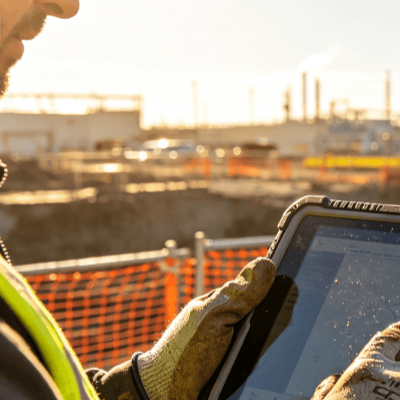
In the modern industrial landscape, a consumer-grade tablet is a liability. While a standard iPad or Galaxy Tab excels in a climate-controlled office, it lacks the structural integrity to survive a manufacturing floor, a humid warehouse, or a remote construction site. This gap is bridged by the “rugged tablet”—a device engineered from the board level up to maintain uptime where traditional electronics fail.
Understanding what defines a rugged tablet requires looking past the reinforced rubber bumpers. It involves analyzing the mechanical engineering, thermal management, and certification standards that allow these devices to serve as the backbone of industrial digital transformation.
Defining the Rugged Tablet: More Than a Protective Case
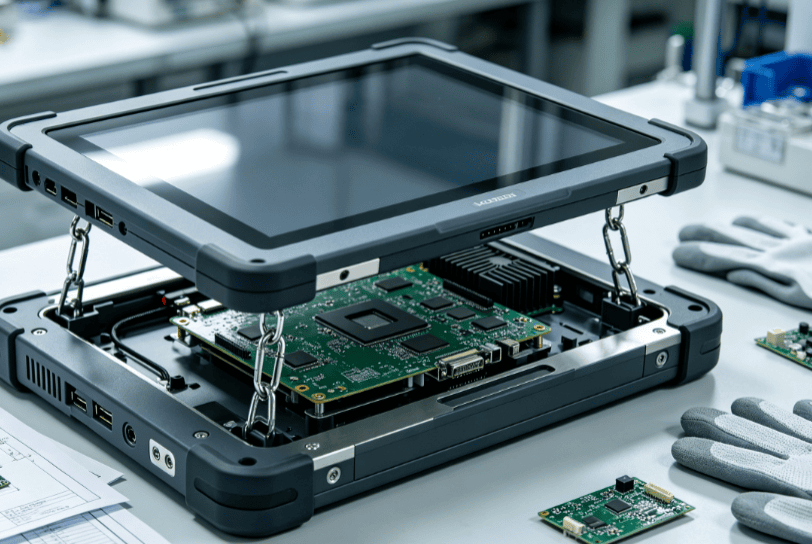
A rugged tablet is a purpose-built mobile computer designed to operate reliably in harsh environments characterized by extreme temperatures, vibrations, moisture, and dust. Unlike consumer tablets paired with “tough” aftermarket cases, a true rugged tablet features internal component reinforcement and specialized sealing.
The engineering of these devices typically follows three tiers of ruggedization:
- Fully Rugged: Designed to meet the most stringent military standards. These devices are sealed against dust and water (often submersible) and can withstand drops from six feet onto concrete.
- Semi-Rugged: A balance between portability and durability. These are often used by field technicians who need protection against occasional drops and light rain but don’t require full submersion capabilities.
- Ultra-Rugged: Often specialized for explosive environments (ATEX/IECEx certified) or extreme maritime conditions.
For engineers and project managers, the “rugged” label is not a marketing term; it is a performance guarantee backed by specific laboratory testing protocols.
The Technical Benchmarks: MIL-STD and IP Ratings
To quantify “toughness,” the industry relies on two primary certification frameworks. When evaluating hardware for industrial deployment, these specifications are the primary indicators of field longevity.
MIL-STD-810G/H (Military Standards)
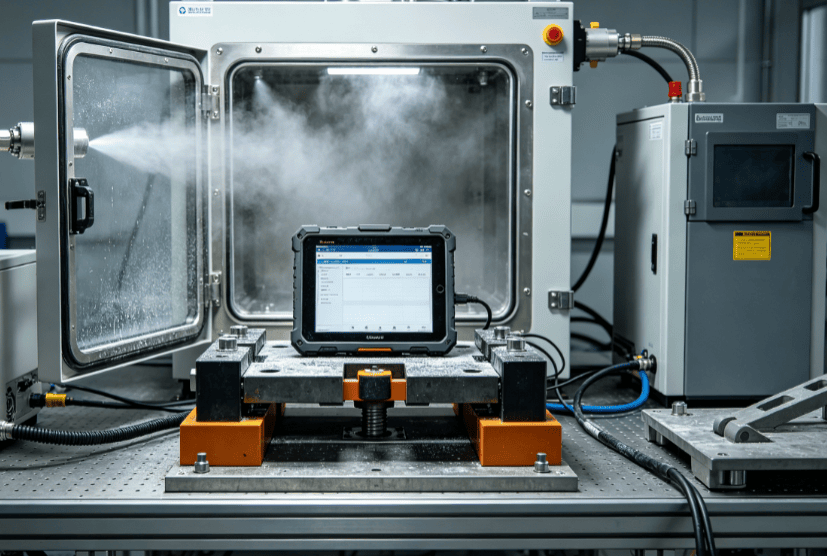
Originally developed by the U.S. Department of Defense, MIL-STD-810H involves a series of rigorous tests. A tablet certified to this standard has undergone:
- Transit Drop Testing: Repeated drops from varying heights to test structural integrity.
- Vibration Resistance: Simulating the constant shaking found in heavy machinery or vehicle mounts.
- Thermal Shock: Moving the device rapidly between freezing and high-heat environments to ensure the PCB (Printed Circuit Board) and screen do not crack.
IP (Ingress Protection) Ratings
The IP rating defines how well the device prevents solids and liquids from entering the internal housing.
- IP65: The first digit (6) indicates the device is completely dust-tight. The second digit (5) means it is protected against water jets from any angle.
- IP67/68: These ratings indicate the tablet can survive full immersion in water for extended periods, essential for outdoor utility work or maritime applications.
Why Industrial Applications Require Ruggedized Hardware
The transition from paper-based workflows to digital interfaces in the field has made hardware reliability a mission-critical factor. If a tablet fails in a warehouse, the operator’s productivity drops to zero. If it fails in a remote oil field, the cost of replacement logistics can far exceed the price of the device itself.
1. Environmental Resilience
Industrial environments are rarely “clean.” In woodworking or metal fabrication, fine particulates can infiltrate a standard tablet’s cooling fans or charging ports, leading to short circuits. Rugged tablets typically utilize fanless cooling designs and sealed I/O ports to mitigate this risk.
2. Display Technology and Outdoor Viewability
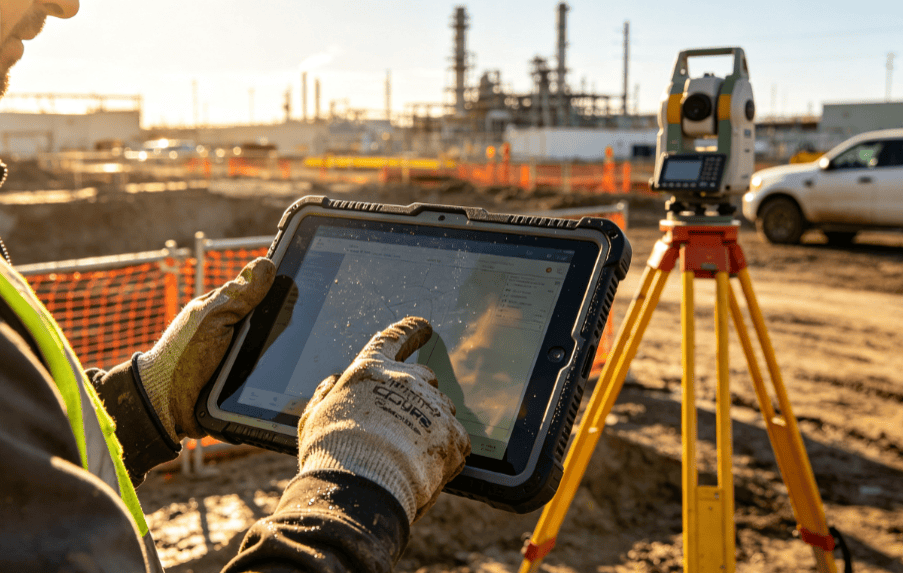
Standard tablets often become unreadable under direct sunlight due to glare and low nit levels. Industrial-grade tablets, such as those utilized by Industrial-TabletPC, employ high-brightness (1000+ nits) displays and optical bonding technology. This reduces internal reflections and ensures data remains visible for surveyors and field engineers working outdoors.
3. Gloved-Hand and Wet-Touch Functionality
Capacitive touchscreens on consumer phones often malfunction when wet or when the user is wearing safety gloves. Rugged tablets utilize specialized touch controllers that can be calibrated for:
- Glove Mode: Allowing operation with heavy industrial gloves.
- Rain Mode: Distinguishing between a finger press and a water droplet to prevent ghost touches.
4. Specialized Connectivity and Modular I/O
While a consumer tablet relies on Wi-Fi and Bluetooth, industrial workflows often require legacy or specialized ports. Rugged tablets frequently feature:
- Native RJ45 Ethernet ports for direct machine diagnostics.
- RS232 Serial ports for communicating with older industrial PLCs.
- Integrated Barcode Scanners (1D/2D): Faster and more accurate than using a camera for high-volume inventory management.
The Role of Long-Term Lifecycle Support
A critical, yet often overlooked, aspect of rugged tablets in industrial applications is product longevity. Consumer electronics operate on a 12-to-18-month refresh cycle. For an OEM or a large-scale manufacturing plant, this is unacceptable.
Industrial tablet manufacturers provide “stable cycles,” meaning the same hardware configuration is available for 3 to 5 years. This allows companies to standardize their software image and mounting hardware without worrying about the next consumer model having a different physical footprint or driver incompatibility.
Strategic Implementation: Matching Hardware to Workflow
Selecting a rugged tablet is not about finding the most expensive device; it is about matching the device’s engineering to the specific stressors of the application.
- For Warehousing & Logistics: The priority is often an integrated barcode scanner, a lightweight chassis for handheld use, and a secure vehicle mount for forklifts.
- For Oil, Gas, and Chemical Processing: The priority shifts toward C1D2 (Class 1 Division 2) certifications to prevent the device from becoming an ignition source in volatile atmospheres.
- For Field Service: Long battery life and “hot-swappable” batteries—which allow the user to change batteries without powering down the device—are essential for full-shift productivity.
As industrial environments continue to integrate IoT (Internet of Things) and real-time data analytics, the rugged tablet acts as the primary human-machine interface (HMI). It is the tool that ensures data flows seamlessly from the edge of the network back to the ERP (Enterprise Resource Planning) system, regardless of the dust, rain, or heat it encounters along the way.
FAQ
Q: Is a rugged tablet just a consumer tablet in a thick case?
A: No. A true rugged tablet is engineered from the inside out. This includes reinforced internal skeletons, shock-mounted components, fanless thermal management, and specialized screens that are chemically strengthened and optically bonded. A case only protects against external impact; it does not address thermal stress or internal component vibration.
Q: What does “Hot-Swappable Battery” mean?
A: This is a feature common in industrial tablets where the device has a small internal bridge battery. This allows the user to remove the main battery and replace it with a fresh one without shutting down the OS or losing data, enabling 24/7 continuous operation.
Q: Can rugged tablets run standard Windows or Android apps?
A: Yes. Rugged tablets are built on standard architectures (typically Intel for Windows or ARM for Android). This ensures they are fully compatible with existing enterprise software, including CAD viewers, ERP systems, and proprietary diagnostic tools.
Q: What is the difference between IP65 and IP67?
A: IP65 means the tablet is protected against low-pressure water jets (like heavy rain or a spray-down). IP67 means the tablet can be completely submerged in water up to 1 meter deep for 30 minutes without damage.
Reference Sources
- Department of Defense Test Method Standard: MIL-STD-810H Environmental Engineering Considerations
- International Electrotechnical Commission: Understanding IP Ratings (IEC 60529)
- IEEE Xplore: The Evolution of Mobile Computing in Industrial Environments
- OSHA Standards: Safety Requirements for Electronic Equipment in Hazardous Locations