

What Is an Industrial Mini PC? Definitions, Tech & Use Cases

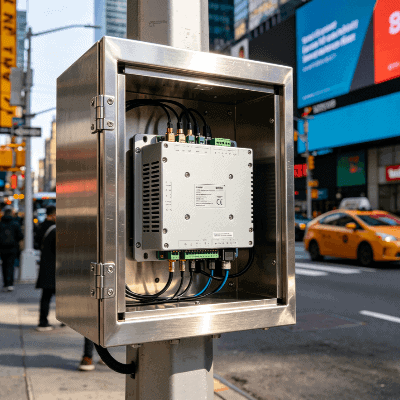
In modern automation and edge computing, the industrial mini PC serves as a critical bridge between high-performance computing and harsh factory environments.Unlike desktop computers found in temperature-controlled offices, these compact units are engineered from the ground up to withstand harsh conditions. As a result, they can operate in environments that would otherwise cause a standard PC to fail within hours.
An industrial mini PC is a small-form-factor computer specifically designed for 24/7 reliability in harsh settings. It integrates industrial-grade components into a rugged, often fanless chassis. In addition, this design provides the processing power required for data acquisition, machine vision, and IoT gateway functions, while eliminating the vulnerability of moving parts.
The Engineering Philosophy: Industrial vs. Consumer PCs
To understand what defines an industrial mini PC, one must look beneath the surface at the hardware architecture. While a consumer-grade NUC or desktop focuses on aesthetic design and peak burst performance, an industrial unit instead prioritizes thermal stability and lifecycle longevity. In contrast, this makes industrial systems more suitable for long-term deployment.
| Feature | Consumer Mini PC | Industrial Mini PC |
|---|---|---|
| Cooling | Active fans (prone to dust intake) | Passive cooling (fanless heatsink) |
| Chassis | Plastic or thin aluminum | Heavy-duty aluminum or stainless steel |
| Lifecycle | 6–18 months (frequent revisions) | 5–10 years (long-term availability) |
| Temp Range | 0°C to 35°C | -20°C to 70°C (typical wide-temp) |
| Input Voltage | Fixed (usually 12V or 19V) | Wide voltage (9V–36V DC) |
| Resistance | Low (fragile to shock/vibration) | High (tested to MIL-STD-810G standards) |
Core Technical Characteristics
For engineers and system integrators, the value of an industrial mini PC lies in its ability to operate where human intervention is difficult or environmental variables are extreme.
1. Passive Cooling and Fanless Design
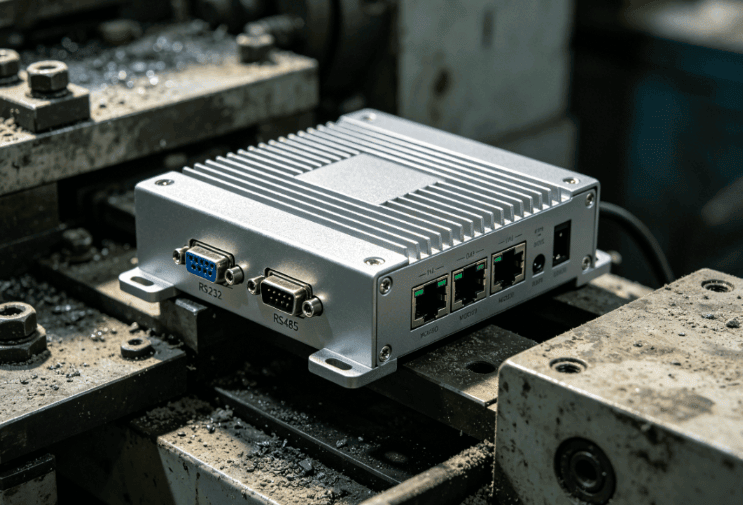
The most significant point of failure in standard computers is the cooling fan. In a manufacturing environment, fans act as vacuums, pulling in metallic dust, oil mist, and debris. This leads to internal short circuits or mechanical fan failure. Industrial mini PCs utilize a fanless design, where engineers design the chassis as a high-efficiency heat-dissipation system using aluminum fin structures. By dissipating heat through fins, the internal components stay sealed and protected.
2. Solid-State Construction
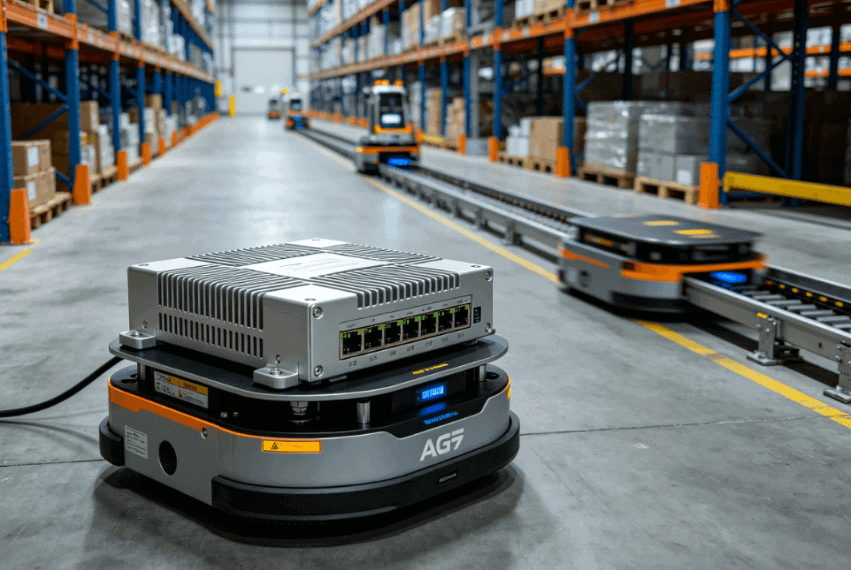
Reliability in high-vibration environments—such as on a moving AGV (Automated Guided Vehicle) or attached to a CNC machine—requires the elimination of all moving parts. Industrial mini PCs typically use Solid State Drives (SSDs) and often feature soldered RAM or “ruggedized” SODIMM slots to ensure that connections do not loosen under mechanical stress.
3. Industrial-Grade I/O and Connectivity
While modern consumer PCs have migrated almost entirely to USB-C, industrial workflows still rely on legacy and specialized protocols. A typical industrial mini PC, such as those found in professional catalogs, will feature:
- RS232/RS485/RS422 Serial Ports: For communication with PLCs, industrial sensors, and legacy automation equipment.
- Dual or Quad Gigabit LAN: For network redundancy and separating internal OT networks from external IT networks.
- GPIO (General Purpose Input/Output): For direct control of relays and digital sensors.
Primary Applications in Industrial Environments
The “where” is just as important as the “what.” Industrial mini PCs are deployed as “Edge” devices, meaning they process data locally to reduce latency and bandwidth costs.
- Machine Vision & Quality Inspection: These units process high-speed camera feeds to detect defects on assembly lines. Their compact size allows them to be mounted directly onto robotic arms or within small enclosures.
- Digital Signage & Wayfinding: In outdoor or semi-outdoor environments like transit hubs, where humidity and temperature fluctuations are common, industrial units provide the reliability needed for 24/7 uptime.
- IIoT Gateways: Acting as a translator, the mini PC collects data from older machinery via Modbus or CAN bus and transmits it to the cloud via MQTT or OPC UA protocols.
- Energy and Infrastructure Monitoring: Frequently used in remote solar farms or wind turbines, these PCs must withstand extreme cold and heat without maintenance for years at a time.
Why Lifecycle Management Matters
In the industrial sector, “compatibility” is a long-term commitment. When a manufacturer integrates a specific computer into a medical device or a control cabinet, they need to know that the exact same hardware will be available five years from now.
Consumer electronics manufacturers change chipsets and board layouts every few months to stay competitive. In contrast, industrial mini PC providers offer long-term support (LTS). This ensures that the drivers, BIOS, and physical dimensions remain identical, preventing costly software re-certifications or physical redesigns of the host machine.
Choosing the Right Architecture
Selecting an industrial mini PC requires matching the processor’s thermal profile to the environment.
- Intel Celeron/Pentium (Low Power): Ideal for simple data logging or thin-client applications where heat generation must be kept to an absolute minimum.
- Intel Core i3/i5/i7 (High Performance): Necessary for edge AI, local database management, or complex SCADA (Supervisory Control and Data Acquisition) software.
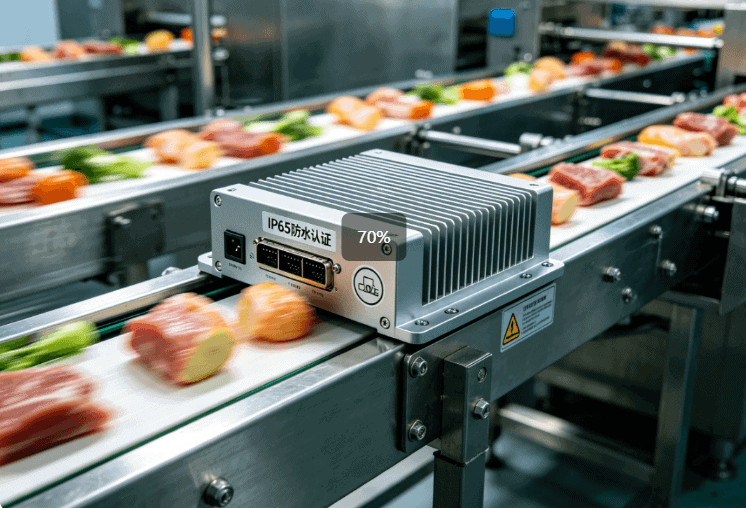
Engineers must also consider the Ingress Protection (IP) rating. While many units are “dust-protected,” certain wash-down environments in food and beverage processing may require fully sealed IP65 or IP67 rated enclosures to survive high-pressure cleaning.
Summary of Benefits for Systems Integrators
From a project management perspective, the industrial mini PC is an investment in reducing the Total Cost of Ownership (TCO). While the initial purchase price is higher than a standard office PC, the elimination of downtime, the reduction in maintenance visits, and the extended lifespan result in significant long-term savings.
For those evaluating hardware for specific projects, it is essential to look for certifications such as CE, FCC, and RoHS, which ensure the device meets safety and electromagnetic interference standards. Many specialized units now also offer DIN-rail mounting or VESA mounting options to simplify integration into existing electrical cabinets.
FAQ
Can an industrial mini PC run Windows 11?
Yes. Most modern industrial mini PCs support Windows 10 IoT Enterprise, Windows 11, and various Linux distributions (such as Ubuntu or Debian). Windows 10 IoT is often preferred in industry because it allows for “locked-down” environments and longer update cycles.
What is the MTBF of these devices?
MTBF stands for Mean Time Between Failures. High-quality industrial mini PCs often have MTBF ratings exceeding 50,000 to 100,000 hours. This is achieved through the use of industrial capacitors and the absence of mechanical wear-and-tear components.
How do I mount an industrial mini PC?
Because space is at a premium in industrial settings, these units usually offer flexible mounting. The most common methods include DIN-rail mounting (standard in electrical cabinets), VESA mounting (on the back of monitors), or Wall-mount brackets for secure attachment to machinery.
Do they support wireless connectivity?
While wired Ethernet is the standard for reliability, most industrial mini PCs include internal Mini-PCIe or M.2 slots to support Wi-Fi, Bluetooth, 4G LTE, or 5G modules with external high-gain antennas for remote communication.
Reference Sources
- IEC 60068-2-27: International standard for testing the shock and vibration resistance of electronic equipment. Link to IEC Standards
- MIL-STD-810G: Department of Defense Test Method Standard for Environmental Engineering Considerations.
- IEEE 802.3: Standard for Ethernet connectivity in industrial automation networks. Link to IEEE
- Intel® IoT Solutions Alliance: Technical documentation regarding industrial-grade silicon and long-term roadmap availability.