

OEM Rugged Tablet Guide: Engineering, Customization & ROI

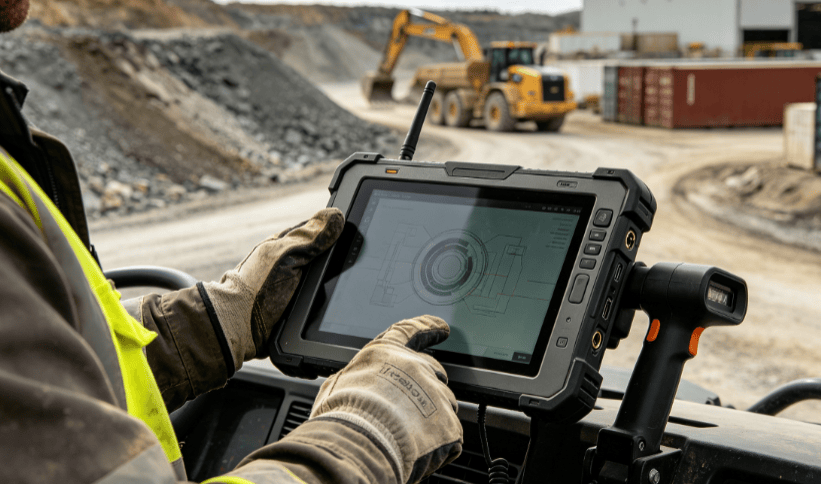
Selecting an OEM rugged tablet is a high-stakes engineering and procurement decision. Unlike consumer-grade devices, industrial tablets must survive extreme thermal cycles, high-vibration environments, and continuous chemical exposure. For project managers and system integrators, the challenge lies in balancing hardware performance with long-term lifecycle stability.
This guide analyzes the critical technical parameters and manufacturing workflows required to deploy successful OEM tablet solutions across industrial sectors.

Defining the OEM Rugged Tablet Architecture
An OEM (Original Equipment Manufacturer) rugged tablet is not a finished retail product. It is a flexible hardware platform designed for deep integration. These devices are engineered with reinforced internal chassis, often utilizing magnesium alloy or high-density polymers to protect sensitive PCBAs from structural torsion.
In an OEM context, “rugged” refers to more than just a thick case. It involves the integration of specialized components:
- Chemically Strengthened Glass: Utilizing Corning® Gorilla® Glass or similar AG (Anti-Glare) coatings.
- Thermal Management: Passive cooling designs that maintain IP-rated seals while preventing CPU throttling.
- Modular I/O: Specialized ports like RS232, RJ45, or aviation plugs not found on consumer devices.
Technical Performance Standards: MIL-STD and IP Ratings
When evaluating an OEM partner, technical compliance is the primary filter for quality. Most industrial applications demand two specific certifications.
1. MIL-STD-810G/H Compliance
This US Military Standard tests equipment limits under environmental stress. A true OEM rugged tablet must undergo “Transit Drop” testing (Method 516.6), where the device is dropped 26 times from 4 feet onto plywood over concrete. For vibration-heavy sectors like mining or trucking, Method 514.6 is essential to ensure internal connectors do not unseat over time.
2. Ingress Protection (IP) Ratings
The IP rating defines the seal’s effectiveness against solids and liquids.
| Rating | Dust Protection | Water Protection | Use Case |
| IP65 | Total dust ingress protection | Protected against low-pressure water jets | Warehousing, Indoor Factory |
| IP67 | Total dust ingress protection | Protected against immersion (1m for 30 min) | Field Service, Construction |
| IP68 | Total dust ingress protection | Protected against continuous submersion | Marine, Extreme Outdoor |
Key Selection Criteria for OEM Projects
Designing an OEM solution requires looking beyond the spec sheet. You must consider how the hardware interacts with your specific software stack and environment.
Operating System Stability: Windows vs. Android
The choice between Windows (IoT Enterprise) and Android (Enterprise Recommended) often dictates the hardware’s lifecycle. Windows offers easier integration with legacy industrial software and SCADA systems. Android provides a more lightweight footprint, ideal for mobile GIS or logistics applications. OEM providers often offer “locked-down” OS versions to prevent unauthorized updates that could break proprietary apps.
Display and Sunlight Readability
For outdoor field use, standard nits (brightness) are insufficient. OEM rugged tablets typically feature high-brightness displays (800–1000 nits) and optical bonding technology. Optical bonding eliminates the air gap between the LCD and the touch panel, significantly reducing internal reflections and improving contrast in direct sunlight.
Connectivity and Data Capture
OEM solutions allow for the integration of specialized modules:
- Dedicated GPS: For sub-meter accuracy in surveying.
- 1D/2D Barcode Scanners: Integrated Zebra or Honeywell scan engines for high-volume logistics.
- RFID/NFC: For secure asset tracking and personnel authentication.
The OEM Customization Workflow
A professional OEM partnership follows a structured engineering path. This ensures the final hardware meets the specific Mean Time Between Failures (MTBF) targets required for industrial deployment.
- Requirements Definition: Analyzing environmental stressors (temp range, humidity, chemical exposure).
- Prototype Development: Modifying the base PCB or chassis to accommodate specific I/O or branding.
- Stress Testing: Subjecting the unit to thermal chambers, salt spray tests, and ESD (Electrostatic Discharge) testing.
- Certification Management: Ensuring the final assembly meets CE, FCC, or ATEX (Explosion Proof) requirements.
- Lifecycle Support: Guaranteeing the availability of the exact hardware configuration for 3–5 years to avoid software re-certification costs.
Industrial Application Logic
The value of an OEM rugged tablet solution varies by industry. Each sector prioritizes different hardware features.
- Logistics & Warehousing: Focuses on drop resistance and long-range Wi-Fi roaming capabilities. Vehicle-mounted docks with power ignition sensing are critical here.
- Manufacturing & Automation: Prioritizes localized I/O (LAN, COM ports) and mounting compatibility (VESA) for integration into CNC or assembly line stations.
- Field Utilities: Demands hot-swappable batteries. This allows technicians to replace batteries in the field without shutting down the device, ensuring zero downtime during 12-hour shifts.
Commercial Realities: TCO vs. Initial Price
Procurement teams often compare the unit price of a rugged tablet to a consumer tablet with a protective case. This is a false equivalence. The Total Cost of Ownership (TCO) of an OEM rugged device is significantly lower due to:
- Reduced Failure Rates: Industrial failure rates are typically <3%, compared to >20% for consumer devices in the same environment.
- Lifecycle Stability: Avoiding the “forced upgrade” cycle every 12 months.
- Deployment Efficiency: Pre-imaged OS and custom BIOS settings save hours of IT labor per unit.
FAQ: OEM Rugged Tablet Procurement
Q: What is the typical MOQ for a fully customized OEM tablet?
A: Most manufacturers require an MOQ (Minimum Order Quantity) of 100 to 500 units for deep hardware modifications. However, minor branding or software imaging can often be done on smaller batches of 20–50 units.
Q: Can we integrate our own proprietary sensors into an OEM tablet?
A: Yes. High-end OEM providers offer PCIe or USB-based internal expansion slots. This allows for the integration of specialized radio modules or proprietary sensor boards within the existing rugged housing.
Q: How do hot-swappable batteries work in rugged environments?
A: The tablet contains a small internal “bridge battery.” This provides 2–5 minutes of power, allowing the user to swap the main external battery pack without losing data or losing the network connection.
Q: Are these tablets compatible with glove-touch and wet-touch?
A: Industrial-grade capacitive screens include a controller tuned for increased sensitivity. This allows the screen to distinguish between a deliberate glove touch and a random water droplet, essential for outdoor or medical use.
Reference Sources
- MIL-STD-810H: Department of Defense Test Method Standard for Environmental Engineering
- IEC 60529: Degrees of protection provided by enclosures (IP Code)
- Android Enterprise: Rugged Device Requirements
- IEEE Xplore: Thermal Management in Ruggedized Mobile Devices