

How Industrial Computers for Smart Manufacturing Drive Industry 4.0 Efficiency

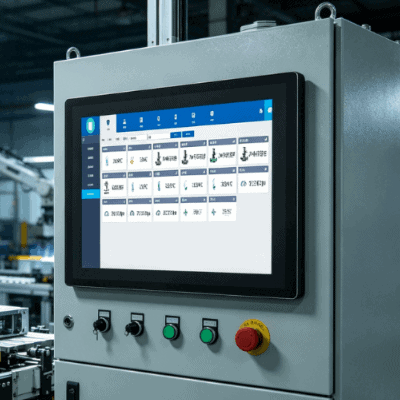
The transition from traditional assembly lines to autonomous, data-driven ecosystems—often termed Industry 4.0—is not merely a software upgrade. It represents a fundamental shift in how physical hardware interacts with digital intelligence. At the epicenter of this transformation is the industrial computer for smart manufacturing. Unlike the hardware found in climate-controlled offices, these ruggedized systems are designed to survive where standard electronics fail, serving as the “nervous system” for modern production facilities.
To understand the value of these systems, one must look beyond the screen and into the architecture of the modern smart factory.
What Defines an Industrial Computer for Smart Manufacturing?
In this context, smart manufacturing context, engineers design an IPC as a high-performance computing platform for continuous operation in harsh environments. While a consumer-grade PC might prioritize aesthetics or peak gaming performance, an IPC prioritizes reliability, longevity, and connectivity.
Smart manufacturing relies on the seamless flow of data between sensors, programmable logic controllers (PLCs), and cloud-based analytics. The industrial computer acts as the bridge. It must process complex algorithms in real-time while being subjected to electromagnetic interference (EMI), high humidity, extreme temperature fluctuations, and constant mechanical vibration.
The Technical Divide: Industrial vs. Commercial Grade
For engineers and project managers, the choice between industrial and commercial hardware is dictated by the cost of downtime. In a high-volume automotive or semiconductor plant, a single minute of system failure can result in thousands of dollars in lost revenue.
| Feature | Consumer/Commercial PC | Industrial Computer for Smart Manufacturing |
| Cooling System | Internal fans (prone to dust intake) | Fanless, passive cooling via heat sinks |
| Operating Temp | 0°C to 35°C | -20°C to 70°C (Extended range) |
| Lifespan/Support | 1–2 years (rapidly obsolete) | 5–10 years (long-term availability) |
| Durability | Plastic/Light Metal casing | IP65/IP67 rated stainless steel or aluminum |
| I/O Connectivity | Limited USB/HDMI | Legacy RS-232/422/485, GPIO, Dual LAN |
How Industrial Computers Enable Edge Computing
One of the most significant roles of an industrial computer for smart manufacturing is “Edge Computing.” Traditionally, factories sent data from the production floor to a centralized cloud server for processing. However, as factories integrate thousands of IoT sensors, the resulting latency and bandwidth costs become unsustainable.
By deploying powerful IPCs at the “edge”—directly on the machine or the production cell—manufacturers can process data locally. As a result,this allows for:
- Real-time Decision Making: If a CNC machine detects a vibration anomaly, the edge computer can trigger an emergency stop in milliseconds, preventing tool breakage.
- Data Filtering: Instead of sending every byte of raw sensor data to the cloud, the IPC filters and sends only relevant performance metrics, reducing cloud storage overhead.
- Security: Keeping critical operational data within the local network reduces the attack surface for external cyber threats.
Mobile Human-Machine Interface (HMI) and Industrial Tablets
In many smart manufacturing setups, fixed workstations are being replaced or supplemented by mobile solutions. This is where Industrial Tablet PCs become vital.
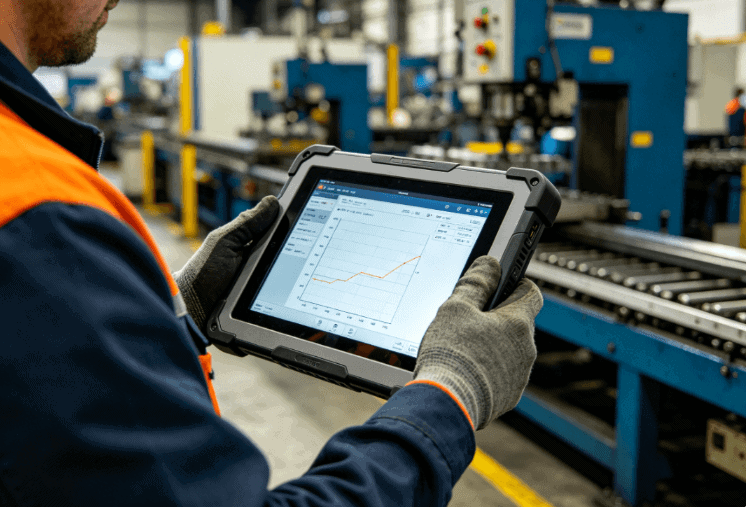
A smart factory requires operators to have data at their fingertips, whether they are performing maintenance on a robotic arm or supervising a chemical mixing process. Engineers use industrial tablet PCs as portable HMIs, providing:
- Workflow Visualization: Real-time 3D models of production progress.
- Asset Tracking: Using integrated RFID or barcode scanners to manage inventory.
- Augmented Reality (AR): Assisting technicians by overlaying digital repair instructions onto physical machinery via the tablet’s camera.
In fact,these tablets are not merely ruggedized iPads; they are full-fledged industrial computers featuring sunlight-readable displays, hot-swappable batteries for 24/7 shifts, and specialized mounting systems for forklifts or AGVs (Automated Guided Vehicles).
Machine Vision and Quality Inspection
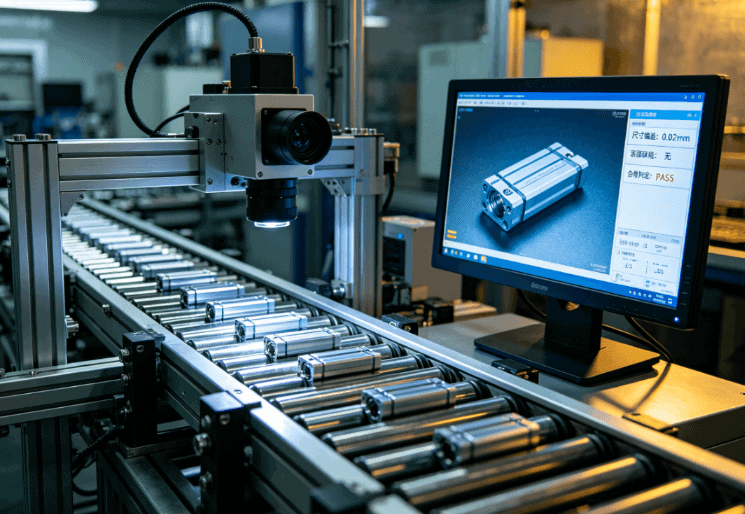
Quality control is perhaps the most visible application of an industrial computer for smart manufacturing. High-speed cameras capture images of products moving along a conveyor belt. Then, the IPC uses a dedicated GPU or VPU to run AI models to detect microscopic defects, incorrect labeling, or missing components.
This requires massive computational throughput and specialized I/O like PoE (Power over Ethernet) or CameraLink to power and trigger multiple high-resolution cameras simultaneously. The result is a “Zero-Defect” manufacturing strategy that was previously impossible with manual human inspection.
Reliability Standards and Engineering Requirements
When integrating an industrial computer into a smart manufacturing ecosystem, specific engineering standards must be met to ensure compatibility and safety:
- Ingress Protection (IP Ratings): In environments involving food processing or heavy machining, computers must be wash-down capable. An IP65-rated system is protected against dust and low-pressure water jets, while IP69K is required for high-pressure, high-temperature steam cleaning.
- Vibration and Shock Resistance: Machines like stamping presses create constant floor vibration. IPCs use Solid State Drives (SSDs) and cable-less internal designs to ensure that no components vibrate loose over time, often adhering to MIL-STD-810G standards.
- Electromagnetic Compatibility (EMC): Heavy motors and high-voltage equipment generate significant electrical noise. Industrial-grade motherboards are designed with enhanced shielding to prevent system crashes or data corruption caused by this interference.
The Future: AI and Autonomous Systems
As we look toward the future of smart manufacturing, the role of the industrial computer will expand into autonomous orchestration. We are seeing the rise of “AI on the Floor,” where computers don’t just follow pre-programmed logic but learn from production variances.
This requires a move toward heterogeneous computing—systems that combine CPUs, GPUs, and FPGAs (Field Programmable Gate Arrays). These “AI-ready” industrial computers will manage the complex coordination required for collaborative robots (cobots) to work safely alongside human operators, adjusting speed and trajectory in real-time based on visual and tactile feedback.
Conclusion
The industrial computer for smart manufacturing is the foundation upon which the modern factory is built. By moving intelligence from the office to the ruggedized edge, manufacturers can achieve unprecedented levels of efficiency, customization, and uptime. Whether it is a rackmount server managing a plant’s data backbone or a waterproof industrial tablet PC in the hands of a floor supervisor, these machines are the essential tools that turn the promise of Industry 4.0 into a functional reality.
FAQ
Can I use a high-end gaming PC for smart manufacturing instead of an industrial computer?
Technically, a gaming PC has the processing power, but it lacks the necessary environmental protections. The fans will quickly clog with industrial dust, the consumer-grade capacitors will degrade under high heat, and the lack of long-term component availability means you won’t be able to find replacement parts in three years when the motherboard fails.
What is the difference between an HMI and an Industrial Computer?
A Human-Machine Interface (HMI) is a specific application of an industrial computer focused on user interaction. While all HMIs are essentially computers, not all industrial computers are HMIs. Many IPCs operate “headless” (without a monitor) inside control cabinets, performing data processing or acting as communication gateways.
How does an industrial computer handle power fluctuations on a factory floor?
Industrial computers are typically designed with wide-range DC power inputs (e.g., 9V to 36V) and include built-in over-voltage and under-voltage protection. Many also feature “ignition control” for use in mobile vehicles and can be paired with industrial-grade UPS systems to ensure a graceful shutdown during total power loss.
Do industrial computers support modern wireless standards like 5G?
Yes. Modern industrial computers for smart manufacturing often include M.2 or mini-PCIe expansion slots for 5G, Wi-Fi 6, and LoRaWAN modules. This is critical for connecting mobile assets like AGVs or remote sensors where cabling is impractical.
Reference Sources
- IEEE Xplore: Research on the application of Edge Computing in Industry 4.0. (https://ieeexplore.ieee.org/)
- International Electrotechnical Commission (IEC): Standard 60529 regarding Ingress Protection (IP) Ratings. (https://www.iec.ch/)
- NIST (National Institute of Standards and Technology): Framework for Smart Manufacturing Operations. (https://www.nist.gov/)
- MIL-STD-810G: Department of Defense Test Method Standard for Environmental Engineering Considerations.