

2027 Industrial All-in-One Computer Guide: Specs & TCO

In 2027, the industrial all-in-one (AIO) computer has evolved from a simple HMI (Human-Machine Interface) into a sophisticated Edge Intelligence hub. As factories transition toward fully autonomous operations and real-time digital twins, the hardware requirements have shifted. A “rugged” exterior is no longer the only benchmark; the focus has moved to sustained computational throughput, AI acceleration, and hyper-connectivity.
For project managers and OEM engineers, selecting an industrial AIO today requires balancing legacy stability with the processing power needed for 2027’s software stacks.
The Shift to Edge AI and NPU Integration
Modern industrial software—ranging from predictive maintenance to AI-driven quality inspection—now demands local processing. When evaluating an industrial all-in-one computer, the CPU core count is only half the story.
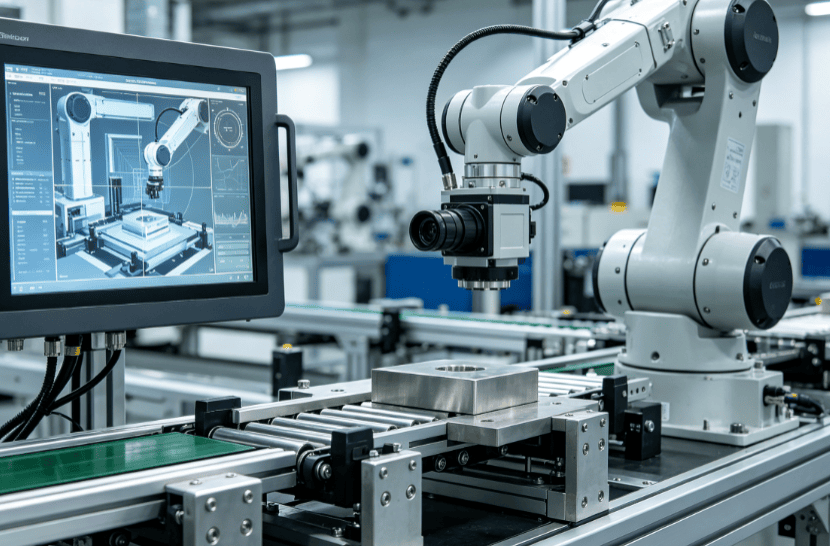
- Integrated NPUs (Neural Processing Units): In 2027, mid-to-high-end industrial AIOs feature processors with dedicated NPUs. This allows for local machine vision processing without taxing the main CPU, ensuring the HMI remains responsive even during heavy data analysis.
- Sustained Performance vs. Burst Speed: Industrial environments lack the airflow of data centers. A high-performance unit is useless if it throttles performance within ten minutes. Look for “Full Load” thermal benchmarks rather than peak clock speeds.
Thermal Engineering: The Fanless Frontier
The move toward more powerful processors has made thermal management more complex. Fanless design remains the gold standard for reliability in environments containing metallic dust, oil mist, or fibers.
- Advanced Heat Dissipation: Premium units, such as those featured on Industrial-TabletPC, utilize fins-array backshells and internal heat pipes. These designs expand the effective cooling surface area, allowing processors with a TDP (Thermal Design Power) of up to 35W or even 45W to operate without mechanical fans.
- Operating Temperature Range: Standard industrial builds should support -10°C to 60°C. For cold storage or smelting applications, “Wide Temperature” modules are required, often extending the range from -30°C to 75°C.
Environmental Sealing: Decoding IP Ratings for 2027
Ingress Protection (IP) is the primary defense against premature hardware failure. However, over-specifying is as costly as under-specifying.
| Requirement | IP Rating | Material Recommended |
| Dusty Warehouse | IP65 (Front) | Aluminum Alloy / ABS |
| CNC Machining Center | IP65 (Full) | Die-Cast Aluminum |
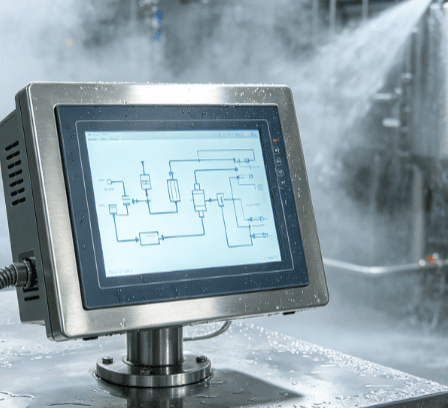
| Pharmaceutical/Food | IP69K | 316L Stainless Steel |
| Outdoor Infrastructure | IP67 | UV-Resistant Treated Metal |
Technical Insight: In washdown environments, the IP69K rating is critical. It protects not just against water, but against high-pressure (1450 psi) and high-temperature (80°C) steam cleaning common in food and medical sectors.
Connectivity: Wi-Fi 7, 5G-Advanced, and TSN
By 2027, the “connected factory” relies on low-latency protocols. Your industrial AIO computer must act as a reliable node within this mesh.
- TSN (Time-Sensitive Networking): Ensure the onboard Ethernet controllers support TSN. This is vital for synchronized motion control and real-time data deterministic communication.
- 5G-RedCap and Wi-Fi 7: For mobile workstations or large-scale deployments where cabling is impossible, Wi-Fi 7 provides the interference-free bandwidth (6GHz) required for high-resolution video streams.
- Isolated I/O: Industrial-grade computers must include isolated COM and LAN ports. This prevents ground loops and protects the motherboard from high-voltage surges caused by heavy machinery.
Display Technology: Beyond Brightness
While 1000-nit “High Brightness” displays are standard for outdoor sunlight readability, 2027 standards emphasize durability and interaction quality.
- G+G (Glass-on-Glass) Capacitive Touch: This provides superior chemical resistance and scratch protection compared to plastic-film capacitive screens.
- IK08/IK10 Impact Rating: For high-traffic or high-risk areas, the screen must resist physical impact. An IK10-rated glass panel can withstand a 5kg steel ball dropped from 40cm.
- Anti-UV and Anti-Glare: For outdoor kiosks, ensure the panel has UV-cut coatings to prevent “browning” or delamination of the LCD over years of sun exposure.
Strategic Procurement: TCO and Lifecycle Support
In a commercial context, the initial purchase price of an industrial AIO is often only 30% of the total cost of ownership (TCO).
Lifecycle Management (The 7-10 Year Rule):
One of the core values of specialized suppliers like Industrial-TabletPC is the “Locked BOM” (Bill of Materials). In consumer electronics, components change based on market price. In industrial manufacturing, the motherboard, chipset, and panel must remain identical for the duration of the project (typically 5+ years) to ensure software compatibility and regulatory compliance.
Customization Capability:
Few industrial projects are “off-the-shelf.” A commercial evaluation should include the supplier’s ability to integrate:
- RFID/NFC readers for operator authentication.
- Specific UPS (Uninterruptible Power Supply) modules for graceful shutdowns.
- Customized mounting (Panel, VESA, or Open Frame) for integration into existing cabinets.

FAQ
Q: How does 5G-Advanced benefit industrial AIO computers in 2027?
A: 5G-Advanced (Release 18+) offers significantly lower latency and better positioning accuracy. For AIOs mounted on AGVs (Automated Guided Vehicles) or mobile carts, it ensures seamless roaming across large factory floors without losing connection to the ERP system.
Q: Can I use a capacitive touch screen in a wet environment?
A: Standard capacitive screens may “ghost touch” when wet. However, modern industrial controllers feature “Water-Rejection” firmware that allows the screen to distinguish between a finger press and a water droplet. For heavy washdown areas, 5-wire resistive touch remains a viable, fail-safe alternative.
Q: What is the typical lead time for customized industrial AIOs?
A: In the 2027 market, standard units are often available in 1-2 weeks. Custom configurations (specific I/O or high-brightness panels) typically range from 4 to 8 weeks, depending on the complexity of the mechanical modifications.
Q: Why is “Wide Voltage” input (9V-36V) important?
A: Industrial power grids are notoriously “dirty.” Voltage drops occur when heavy motors start, and spikes occur when they stop. A wide-voltage DC input with built-in surge protection acts as a buffer, preventing motherboard burnout or data corruption during power fluctuations.
Reference Sources
- IEC 61131-3: International standard for programmable controllers and industrial computers.
- ISO 14159: Safety of machinery—Hygiene requirements for the design of machinery (relevant for IP69K stainless steel AIOs).
- Intel Industrial IoT Insights: Technical documentation on NPU integration and Edge AI performance.
- IEEE 802.11be: Technical specifications for Wi-Fi 7 in industrial high-interference environments.