

Choosing the Best Fixed Mount Industrial Tablet for Your Site


Selecting a fixed mount industrial tablet involves more than just picking a screen size. In rugged environments like CNC workshops or long-haul logistics, consumer-grade hardware fails within weeks due to thermal stress and vibration.
A fixed mount industrial tablet is a specialized computing device designed for permanent or semi-permanent installation in demanding environments. Unlike handheld rugged tablets, these units prioritize consistent power delivery, specialized I/O (Input/Output) ports, and rigid mounting interfaces like VESA or RAM mounts.
For engineers and project managers, the choice depends on where the data meets the dirt. Whether it is a forklift dashboard or a cleanroom assembly line, the hardware must match the environmental stressors.

What Defines a Fixed Mount Industrial Tablet?
The primary distinction of a fixed mount unit is its ability to withstand constant mechanical stress while providing reliable connectivity. These devices often lack internal batteries, or use small bridge batteries, because they rely on the vehicle or factory’s power grid.
In factory settings, these tablets function as Human-Machine Interfaces (HMI). They bridge the gap between the operator and the Programmable Logic Controller (PLC). In vehicles, they act as telematics hubs, managing everything from GPS tracking to engine diagnostics via CAN bus integration.
Reliability in these roles requires fanless cooling systems. By eliminating moving parts, manufacturers prevent dust and metallic particles from being sucked into the internal circuitry, which is a common cause of failure in standard PCs.
Vehicle vs. Factory: Identifying Environmental Demands
The requirements for a tablet mounted in a long-haul truck differ significantly from one mounted on a stationary pharmaceutical packaging line. Understanding these nuances prevents over-specifying hardware and wasting budget.
Vehicle-Mount Requirements:
- Vibration and Shock: Units must meet MIL-STD-810G standards to survive the constant rattling of a forklift or heavy-duty truck.
- Wide Voltage Input: Vehicles experience power surges during ignition. Tablets need 9V-36V wide-range DC input with ignition sensing to protect the motherboard.
- High-Brightness Displays: For outdoor use, screens require at least 1,000 nits of brightness to remain readable under direct sunlight.
Factory-Floor Requirements:
- Ingress Protection (IP): If the environment involves washdowns (like food processing), an IP65 or IP67 rating is mandatory to prevent water and oil penetration.
- Diverse I/O Ports: Factory tablets often need legacy support, such as RS232/RS485 serial ports, to communicate with older industrial equipment.
- Chemical Resistance: Screens must be built with chemically strengthened glass to resist damage from industrial cleaning agents or cooling lubricants.
Technical Performance and Selection Criteria
When evaluating options, such as those found in the Industrial Tablet PC category, focus on the internal architecture. The processor choice dictates both the power consumption and the longevity of the deployment.
| Feature | Vehicle-Mount Tablet | Factory/Fixed HMI Tablet |
| Cooling | Fanless / Heat Sink | Fanless / Sealed Housing |
| Mounting | RAM Mount / U-Bracket | VESA 75/100 / Panel Mount |
| Connectivity | 4G/5G LTE, GPS, CAN Bus | Dual LAN, Wi-Fi 6, RS485 |
| Touch Screen | Projected Capacitive (Gloved) | Resistive or Capacitive |
| Power | Ignition Sensing (9-36V) | Standard DC or PoE+ |
Thermal management is a critical “invisible” spec. In a factory, ambient temperatures might remain steady, but in a vehicle cabin, temperatures can swing from -20°C to 70°C. Industrial-grade components are rated for these extremes, whereas commercial chips will throttle performance to prevent melting.
Furthermore, consider the “Repair vs. Replace” cycle. Industrial tablets offer long-term availability, often 5 to 7 years. This ensures that if a unit is damaged in three years, you can source the exact same model without needing to redesign your mounting brackets or software image.
Mounting Standards and Ergonomics
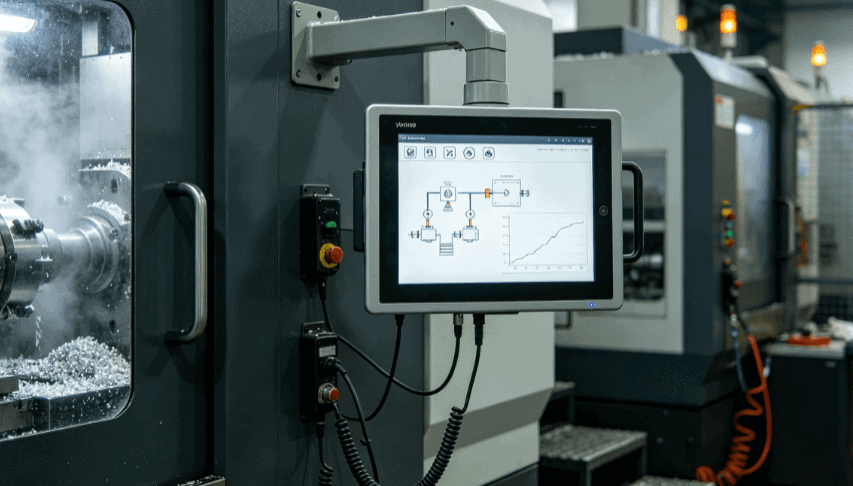
The “fixed” part of the fixed mount industrial tablet is often an afterthought, yet it determines operator safety. A poorly mounted 10-inch tablet in a forklift can create blind spots or become a projectile during a collision.
Most industrial units adhere to VESA (Video Electronics Standards Association) patterns, typically 75mm x 75mm or 100mm x 100mm. This allows for compatibility with a vast range of heavy-duty arms and pedestals.
In high-vibration scenarios, look for “locking” I/O connectors. Standard USB cables will wiggle loose over time. Industrial tablets often feature screw-lock aviation connectors (M12) or cable strain relief brackets to ensure that the power and data cables remain seated regardless of the terrain.
Commercial Considerations: TCO Over Initial Price
The initial purchase price of an industrial tablet is higher than a consumer alternative. However, the Total Cost of Ownership (TCO) is significantly lower when you factor in downtime.
If a $500 consumer tablet fails on a production line, the cost isn’t just the $500 for a new one. It is the cost of the idle operators, the delayed shipment, and the engineering time required to reinstall the software. Industrial units are built to minimize these “hidden costs” through high Mean Time Between Failures (MTBF) ratings.
When requesting a quote or evaluating a supplier, ask about customization. Often, a standard model may need an additional RFID reader for operator check-ins or a specific internal expansion card. Reputable manufacturers can usually modify the I/O shield to accommodate these project-specific needs.

FAQ
What is the difference between IP65 and IP67 for industrial tablets?
IP65 means the tablet is protected against dust and low-pressure water jets from any direction. IP67 offers the same dust protection but allows the device to be submerged in up to 1 meter of water for 30 minutes. Most factory environments only require IP65 unless the unit is subjected to heavy washdown cycles.
Can I run standard Windows 10/11 on these tablets?
Yes, most fixed mount industrial tablets support Windows 10 IoT Enterprise, which is designed for industrial use, or various Linux distributions. This allows for seamless integration with existing ERP and SCADA software.
What is “Ignition Sensing” in vehicle tablets?
Ignition sensing is a power management feature that detects when the vehicle’s engine is turned on or off. It allows the tablet to boot up automatically when the driver starts the vehicle and perform a graceful shutdown after the engine stops, preventing data corruption and battery drain.
Are these tablets sunlight readable?
Not by default. To be truly sunlight-readable, a tablet needs a high-brightness backlight (usually over 800-1000 nits) and often optical bonding, which reduces internal reflections between the LCD and the touch glass.
What is the typical lead time for custom I/O configurations?
For minor I/O modifications, lead times typically range from 4 to 8 weeks, depending on the manufacturer’s production cycle and component availability. Standard models are often available for immediate shipping.
Reference Sources:
- IEC 60529: The international standard for Ingress Protection (IP) ratings. Link to IEC Standards
- MIL-STD-810G: Department of Defense Test Method Standard for Environmental Engineering Considerations. Link to Official Document
- VESA Mounting Standards: Guide to flat display mounting interfaces. Link to VESA