

Reducing Equipment Downtime with Shockproof Tablets

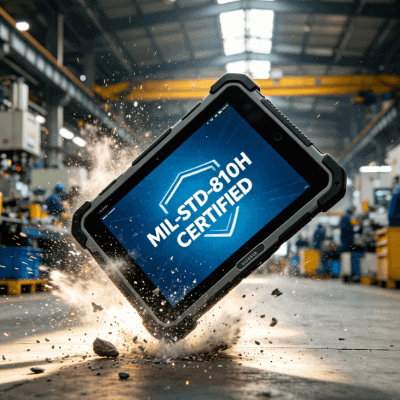
In high-stakes industrial environments, the “fragility” of consumer-grade hardware is a hidden operational tax. When a tablet used for machine diagnostics or inventory management fails due to a drop or constant vibration, the resulting equipment downtime often costs significantly more than the hardware itself.
Equipment downtime isn’t just about a broken screen. It triggers a cascade of inefficiencies: idle technicians, delayed maintenance logs, and halted production lines. For engineers and facility managers, transitioning to a shockproof tablet is a strategic move to safeguard the continuity of digital workflows.

What Defines a Truly Shockproof Tablet?
The term “shockproof” is frequently misused in consumer electronics. In an industrial context, it refers to a device engineered to survive mechanical shocks and repetitive vibrations that would shatter standard hardware.
True shock resistance is validated by the MIL-STD-810H standard. This United States Military Standard tests equipment under rigorous conditions, including functional shock and transit drops. To achieve this rating, a tablet must survive multiple drops from heights of 4 to 6 feet onto plywood over concrete, ensuring that the internal components—not just the outer shell—remain operational.
Unlike consumer tablets that rely on a thin glass sandwich design, industrial shockproof tablets utilize:
- Magnesium Alloy Internal Frames: To provide structural rigidity without adding excessive weight.
- Elastomeric Bumpers: Corner protections that absorb and dissipate kinetic energy.
- Chemically Strengthened Glass: Often utilizing Gorilla Glass or similar compositions with increased depth of compression.
3 Ways Shockproof Tablets Reduce Equipment Downtime
The integration of rugged mobile computing directly impacts the Mean Time Between Failure (MTBF) for facility operations. Here is how shockproof engineering translates into operational uptime.
1. Mitigation of “Vibration Fatigue” in Vehicle-Mount Scenarios
In logistics and warehousing, tablets are often mounted to forklifts or AGVs (Automated Guided Vehicles). These environments subject hardware to constant, low-frequency vibrations. In standard tablets, this leads to “vibration fatigue”—where internal solder joints crack or ribbon cables loosen over time.
Shockproof tablets are designed with reinforced internal connectors and dampening materials that isolate the motherboard from the chassis. By preventing these micro-failures, facilities avoid the sudden “blackout” of a device during a critical picking shift.
2. Elimination of “Dropped Device” Repair Cycles
In field service and maintenance, a dropped tablet usually means a technician must return to the base, sync a new device, and potentially lose unsaved diagnostic data.
A shockproof tablet, such as those found in the Industrial Tablet PC category, is built to be “drop-ready.” When a device can survive a fall from a mezzanine or a service ladder, the work doesn’t stop. The technician simply picks up the device and continues the inspection, maintaining the scheduled maintenance window.
3. Protection of Solid-State Integrity
Industrial tablets exclusively use Solid State Drives (SSD) rather than spinning hard drives, but even SSDs can fail under extreme shock if the mounting isn’t secure. Shockproof engineering ensures that the storage medium is thermally and mechanically decoupled from the outer casing. This protects the integrity of local data, preventing the “software corruption” downtime that often follows a physical impact.

Technical Engineering: Internal Damping vs. External Protection
To understand why these devices reduce downtime, one must look at the cross-section of the hardware. Equipment failure in the field is rarely just about a cracked screen; it is usually about internal component displacement.
| Feature | Consumer Tablet | Shockproof Industrial Tablet |
|---|---|---|
| Chassis Material | Plastic or Thin Aluminum | Magnesium Alloy or PC+ABS |
| Component Mounting | Adhesive and Pressure | Screwed-down Brackets & Gaskets |
| Screen Protection | Minimal Bezel | Raised Edges (Corner Protection) |
| Vibration Rating | None | MIL-STD-810H Method 514.8 |
| I/O Ports | Exposed | Sealed & Reinforced |
By utilizing a “floating” internal architecture, industrial tablets allow the outer shell to flex slightly upon impact while the sensitive PCB (Printed Circuit Board) remains stationary. This engineering philosophy prioritizes the “survival of the data path” over aesthetics.
Real-World Application: The Shop Floor and Field Service
In Predictive Maintenance (PdM), technicians use tablets to run vibration analysis and thermal imaging on CNC machines or hydraulic presses. If the tablet fails, the maintenance window is missed. If the window is missed, a minor bearing issue could escalate into a catastrophic machine failure.
In this scenario, the shockproof tablet acts as an insurance policy for the entire production line. By ensuring the diagnostic tool is as rugged as the machine it is testing, manufacturers reduce the risk of “blind spots” in their maintenance schedule.
Furthermore, these tablets often feature hot-swappable batteries. This is a critical “uptime” feature. When a battery runs low, a user can swap it for a fresh one without shutting down the OS or closing active diagnostic applications. This ensures the device remains in the field for 24/7 multi-shift operations.
Total Cost of Ownership (TCO) Logic
While the upfront cost of a shockproof tablet is higher than a consumer equivalent, the TCO tells a different story.
- Hardware Replacement Savings: A rugged tablet typically has a lifecycle of 5–7 years, whereas consumer tablets in industrial use are often replaced every 12–18 months.
- Labor Continuity: Calculating the hourly rate of a specialized engineer helps quantify the cost of a device failure. If an engineer sits idle for two hours due to a broken tablet, the “cost” of that failure has already exceeded the price difference of a rugged device.
- IT Support Overhead: Rugged devices require fewer helpdesk tickets and less time spent on “ghost in the machine” issues caused by internal vibration damage.
Final Considerations for Implementation
When selecting a tablet to reduce downtime, consider the specific “shock” profile of your environment.
- High Vibration: Look for vehicle-grade vibration ratings.
- High Drop Risk: Prioritize MIL-STD-810H 6-foot drop specifications.
- Extreme Temps: Shock resistance can be compromised by extreme cold (which makes plastics brittle); ensure the device is rated for the operating temperature of your facility.
By aligning hardware specifications with the physical realities of the workspace, industrial operators can effectively eliminate mobile hardware as a point of failure in their equipment maintenance workflows.

FAQ
Q: Is a shockproof tablet the same as a waterproof tablet?
A: No. Shockproof refers to mechanical impact and vibration resistance (MIL-STD-810H). Waterproof refers to ingress protection against liquids (IP ratings like IP65 or IP67). However, most high-quality industrial tablets are designed to meet both standards.
Q: Can a shockproof tablet survive a drop onto a screen-facing object?
A: Most shockproof tablets feature a “raised bezel” that protects the glass from flat-surface drops. However, a direct hit to the glass by a sharp object can still cause damage, which is why industrial units use thicker, chemically strengthened glass to minimize this risk compared to consumer devices.
Q: Does “shockproof” mean the internal data is safe?
A: Generally, yes. Because these devices use flash storage (no moving parts) and are engineered to prevent internal component detachment, the data is much safer during a fall than it would be in a standard laptop or consumer tablet.
Q: How do I know if a tablet is truly industrial-grade?
A: Look for independent test reports or certifications for MIL-STD-810H and IP ratings. True industrial manufacturers provide detailed “Ruggedness” datasheets that go beyond marketing terms.
Reference Sources
- United States Department of Defense: MIL-STD-810H Environmental Engineering Considerations and Laboratory Tests.
- VDC Research: Total Cost of Ownership Models for Mobile Computing in Enterprise Environments.
- IEC (International Electrotechnical Commission): IEC 60529 – Degrees of protection provided by enclosures (IP Code).
- IEEE Xplore: Studies on Vibration Fatigue in Electronic Interconnects for Harsh Environments.