

Best Outdoor Rugged Tablet Features: A B2B Field Performance Guide

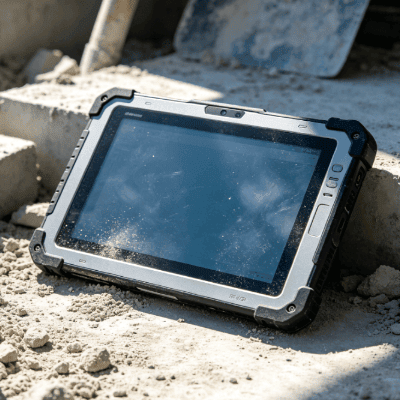
Selecting an outdoor rugged tablet requires a shift in mindset from consumer electronics to industrial-grade hardware. Field environments subject devices to extreme thermal shifts, high-velocity impacts, and saturated moisture. A standard tablet often fails within hours under direct sunlight or in dusty construction zones.
For project managers and engineers, a “rugged” label is not enough. You must evaluate specific hardware architectures that ensure 99.9% uptime in the field. This guide breaks down the critical features that differentiate a professional industrial tool from a fragile consumer alternative.

High-Nit Displays and Sunlight Readability
The primary challenge for any outdoor rugged tablet is screen visibility under direct solar load. Standard tablets typically offer 300 to 400 nits of brightness. This is insufficient for outdoor use, where ambient light washes out the interface.
Professional outdoor tablets utilize high-brightness panels reaching 700 to 1,000+ nits. These displays often incorporate optical bonding technology. This process eliminates the air gap between the touch layer and the LCD.
Optical bonding reduces internal reflections and improves contrast significantly. It also prevents internal condensation in high-humidity environments. For maximum clarity, look for screens with anti-reflective (AR) and anti-glare (AG) coatings to minimize bounce-back light.
Ingress Protection (IP) and MIL-STD-810H Standards
Durability in the field is measured by standardized testing protocols. An outdoor rugged tablet should carry at least an IP65 rating. This ensures the device is dust-tight and protected against water jets from any angle.
For more extreme conditions, such as heavy rain or immersion, IP67 or IP68 ratings are preferred. These ratings indicate the device can survive submersion in water for specific durations. Total seal integrity is vital for protecting internal PCBs from corrosive elements.
Beyond water, look for MIL-STD-810H certification. This US military standard tests equipment against 28 different environmental conditions. These include mechanical shock, vibration, salt fog, and altitude. A MIL-STD-810H tablet can typically survive a 4-foot drop onto concrete while operational.
Thermal Management and Wide Operating Temperatures
Outdoor temperatures can fluctuate from sub-zero winters to scorching summer heat. Standard lithium-ion batteries and processors often throttle or shut down above 35°C (95°F). Industrial tablets are engineered with advanced thermal dissipation systems.
High-quality rugged devices support operating temperatures from -20°C to +60°C. They often utilize magnesium alloy chassis instead of plastic. Magnesium acts as a heat sink, drawing heat away from the CPU without requiring open vents.
This fanless design is critical for maintaining the IP rating. It prevents dust and moisture from being sucked into the internal components. For cold-weather use, some tablets even include internal heaters for the battery and display.
Power Persistence: Hot-Swappable Battery Systems
In the field, a dead battery translates to a complete work stoppage. Many modern outdoor rugged tablets feature hot-swappable battery technology. This allows the user to replace a low battery without shutting down the OS.
A small internal bridge battery maintains power for several minutes during the swap. This feature is essential for 24/7 shifts or long-range field surveys. It removes the need to return to a vehicle or office for charging.
When evaluating power, consider the capacity in watt-hours (Wh) rather than just “hours of use.” Field usage with high-brightness screens and GPS enabled consumes power rapidly. Large-capacity batteries or dual-battery configurations are standard for professional-grade deployments.

Comparison of Rugged Tablet Performance Tiers
| Feature | Standard Rugged | Ultra-Rugged (Industrial) |
| Brightness | 400 – 500 Nits | 800 – 1000+ Nits |
| IP Rating | IP54 / IP65 | IP67 / IP68 |
| Drop Rating | 3 Feet (0.9m) | 4 to 6 Feet (1.2m – 1.8m) |
| Battery | Internal / Non-swappable | Hot-Swappable / Dual-Battery |
| Touch Mode | Standard Touch | Glove & Wet-Hand Tracking |
Connectivity and Precision GNSS
Fieldwork often occurs in remote areas with poor cellular coverage. An outdoor rugged tablet must offer robust connectivity options beyond standard Wi-Fi. Look for devices with dedicated GPS/GNSS modules like u-blox.
These modules provide sub-meter accuracy, which is vital for GIS mapping and asset tracking. Integrated 4G LTE or 5G modules with external antenna pass-throughs ensure reliable data transmission. These pass-throughs allow the tablet to use high-gain antennas mounted on vehicles.
Furthermore, Bluetooth 5.0 and Dual-Band Wi-Fi are necessary for connecting to peripheral sensors. This includes laser rangefinders, thermal cameras, or OBD-II scanners. Stable connectivity ensures that field data syncs with the central server in real-time.
Integrated I/O and Modular Expansion
Unlike consumer tablets, industrial units provide physical ports for specialized hardware. Common requirements include RS-232 serial ports, RJ45 Ethernet, and dedicated USB-A ports. These ports allow direct connection to legacy machinery and industrial PLCs.
Many outdoor tablets also support modular expansions. This includes integrated 1D/2D barcode scanners, NFC readers, and RFID modules. These integrated tools are far more durable than external dongles or Bluetooth attachments.
At Industrial-TabletPC, we offer a range of customizable rugged tablets. Our units, such as the 10-inch and 12-inch Windows/Android models, feature reinforced corners and sunlight-readable glass. These are designed specifically for OEM/ODM projects requiring high reliability.
Conclusion: Evaluating Total Cost of Ownership (TCO)
The initial price of an outdoor rugged tablet is higher than a consumer device. However, the Total Cost of Ownership (TCO) is significantly lower over a 3-to-5-year cycle. Failure rates for consumer tablets in the field can exceed 30% annually.
Rugged devices minimize downtime, repair costs, and data loss. When choosing a tablet, prioritize display NITs, IP ratings, and battery swap capabilities. These features ensure your field team remains productive regardless of the environment.

FAQ
Q: Can I use a rugged tablet in heavy rain?
A: Yes, if the tablet has an IP65 or IP67 rating. Most industrial rugged tablets also feature a “Rain Mode” for the touch screen. This prevents water droplets from being registered as false touches.
Q: What is the difference between MIL-STD-810G and 810H?
A: MIL-STD-810H is the newer version of the standard. It includes more rigorous testing procedures for vibration and shock. It is currently the highest standard for commercial rugged electronics.
Q: How much does a custom rugged tablet cost?
A: Pricing depends on the screen size, CPU, and integrated modules like RFID or high-precision GPS. For B2B procurement, MOQ usually starts at a low threshold for standard models. Custom OEM/ODM configurations may require higher volumes.
Q: Is Windows or Android better for outdoor use?
A: Windows is preferred for legacy industrial software and complex file management. Android is often chosen for lightweight field apps, better battery efficiency, and lower hardware costs.
Reference Sources
- MIL-STD-810H Test Method Standard: Department of Defense – Environmental Engineering Considerations
- IEC 60529 – Degrees of Protection Provided by Enclosures (IP Code): International Electrotechnical Commission
- Brightness Measurement Standards (NITs): Society for Information Display (SID)
- Magnesium Alloy in Electronics: International Magnesium Association