

Fanless Industrial Mini PC Buying Guide: Selecting Hardware for 24/7 Reliability

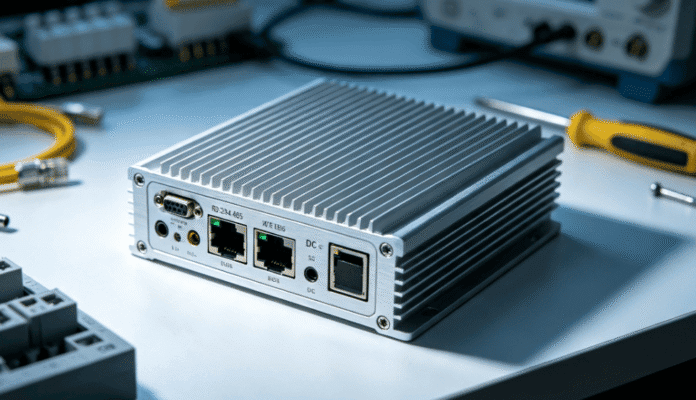
Standard office computers fail quickly when deployed in manufacturing environments. Dust, vibration, and extreme temperatures require a specialized hardware approach. A fanless industrial mini PC solves these challenges by replacing moving parts with passive cooling systems.
Choosing the right unit involves balancing processing power with thermal constraints. This guide provides engineers and procurement managers with the technical criteria needed to evaluate industrial computing hardware for factory floors and IoT gateways.
Why Fanless Architecture is Essential for Industrial Reliability
The primary failure point in industrial computing is the cooling fan. In a factory setting, fans act as vacuums, pulling in metallic dust and oil mist that coat internal components. This leads to overheating, component degradation, and eventual system failure.
A fanless industrial mini PC utilizes a high-efficiency aluminum alloy chassis with integrated heat sinks. These ridges increase the surface area, allowing heat to dissipate naturally through convection. This “sealed” design protects internal electronics from airborne contaminants and significantly increases Mean Time Between Failure (MTBF).
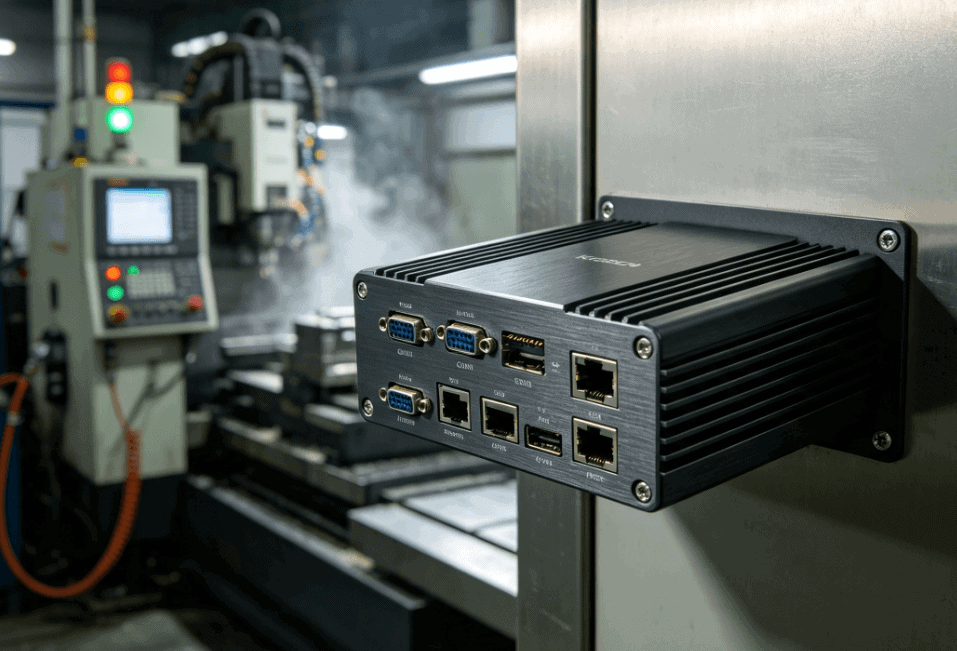
Furthermore, the absence of moving parts makes these units inherently resistant to high-vibration environments. Whether mounted on a CNC machine or inside a mobile AGV, a fanless system maintains connection integrity better than traditional PCs.
Core Technical Parameters: Navigating the Spec Sheet
When evaluating a fanless industrial mini PC, technical specifications must match the specific stresses of your application. General-purpose benchmarks rarely tell the whole story for industrial use.
| Feature | Industrial Requirement | Why It Matters |
| Processor (CPU) | Low TDP (15W – 35W) | Minimizes heat generation in sealed enclosures. |
| Power Input | Wide Voltage (9V – 36V DC) | Handles fluctuations in factory power grids. |
| Operating Temp | -20°C to 70°C | Ensures stability in unconditioned environments. |
| I/O Ports | RS-232/485, Dual LAN, GPIO | Required for PLC communication and legacy sensors. |
| Storage | Industrial-grade SSD (mSATA/NVMe) | High-temperature resistance and shock protection. |
Performance is often limited by the Thermal Design Power (TDP). For basic data logging and IoT gateways, Intel Celeron or Atom processors are ideal. For heavy edge computing or AI vision, Core i5/i7 “U-series” processors provide high performance within strict thermal limits.
Environmental Compatibility and Mounting Logic
Industrial environments vary from clean rooms to offshore oil rigs. Your choice must reflect the physical constraints of the installation site.
Ingress Protection (IP Ratings)
If the PC is exposed to liquid spray or heavy washdowns, look for IP65 or higher ratings. For standard indoor factory use, a standard finned chassis is sufficient for dust protection.
Mounting Options
Unlike desktop PCs, industrial units must be secured to prevent cable strain. Professional models from Industrial Tablet PC offer three primary mounting methods:
- VESA Mount: Ideal for attaching the PC to the back of a monitor.
- Wall/Bracket Mount: Best for cabinet sides or machine frames.
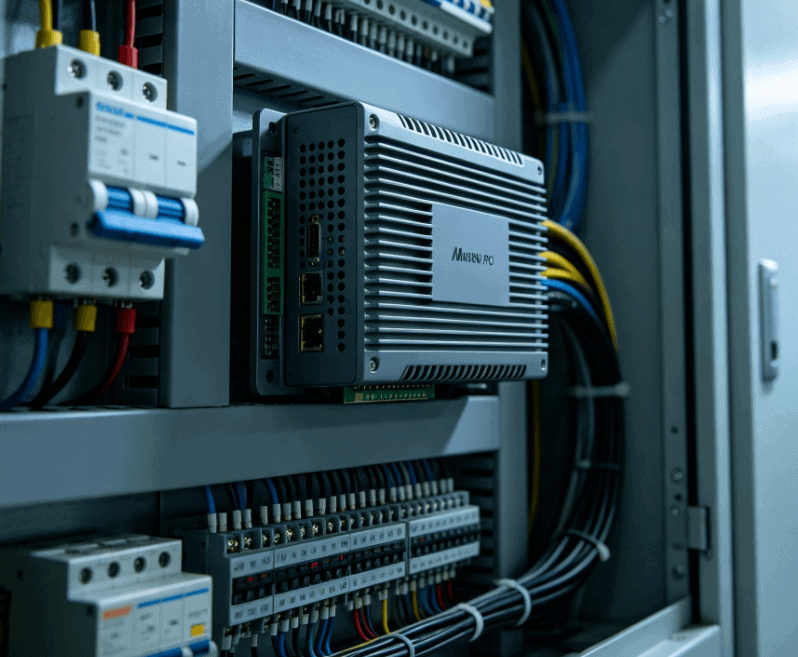
- DIN-Rail Mount: The industry standard for electrical control panels.

Application-Specific Selection Criteria
Matching the computer to the task prevents overspending on unnecessary features while ensuring the system isn’t underpowered.
1. Factory Automation & PLC Interfacing
These applications require high-density I/O. Look for multiple COM ports (RS-232/422/485) and isolated GPIO. This allows the fanless industrial mini PC to act as a bridge between legacy machinery and modern ERP systems.
2. Digital Signage and Outdoor Kiosks
Thermal management is the priority here. Kiosks often sit in direct sunlight, creating a “greenhouse effect” inside the enclosure. High-brightness support and wide-temperature components are non-negotiable for these scenarios.
3. IoT Edge Gateways
For data collection, processing power is less critical than connectivity. Look for units with dual Mini-PCIe slots to support both Wi-Fi and 4G/5G modules simultaneously. This ensures redundant data transmission in remote locations.
Procurement and Customization Evaluation
For project managers, the hardware is only one part of the equation. Industrial projects often span several years, making long-term availability a critical factor.
When sourcing a fanless industrial mini PC, verify the product lifecycle. Reputable suppliers provide “Roadmap Support,” guaranteeing that the same model will be available for 5 to 10 years. This prevents the need for constant software re-certification when a unit needs replacement.
Customization is also a key differentiator. Industrial applications often require specific BIOS settings, such as “Auto Power On” after a power failure or customized I/O configurations. Ensure your supplier can perform these modifications at the factory level to maintain warranty integrity.
FAQ: Common Questions in Industrial PC Selection
Q: Can a fanless PC handle high-performance tasks like 4K video or AI?
A: Yes, but only if the chassis is engineered for it. Modern fanless systems can support Core i7 processors by using advanced thermal piping, though they may throttle performance if ambient temperatures exceed 60°C.
Q: What is the benefit of wide-voltage DC input?
A: Industrial environments often have unstable power or use 24V DC rails. Wide-voltage support (e.g., 9V-36V) protects the internal components from surges and allows for direct integration into machine power systems without external adapters.
Q: How do I choose between an Industrial Mini PC and a Rugged Laptop?
A: Mini PCs are designed for fixed, 24/7 operation inside enclosures or on machines. Rugged laptops are for mobile field service. If the device stays in one place, the Mini PC offers better cost-efficiency and I/O density.
Q: Is SSD storage mandatory for fanless systems?
A: Absolutely. Mechanical HDDs generate their own heat and are susceptible to vibration. Industrial-grade SSDs are the only reliable storage medium for fanless architectures.
Reference Sources
- IEC 60068-2-64: Environmental testing – Part 2-64: Test methods – Vibration, broadband random and guidance.
- MIL-STD-810H: Department of Defense Test Method Standard for Environmental Engineering Considerations and Laboratory Tests.
- Intel Technical Documentation: Thermal Design Power (TDP) and Passive Cooling Architectures.
- IPC-A-610: Acceptability of Electronic Assemblies in Industrial Environments.