
RFID Handheld Reader vs Barcode Scanner: Speed, Tags and Costs

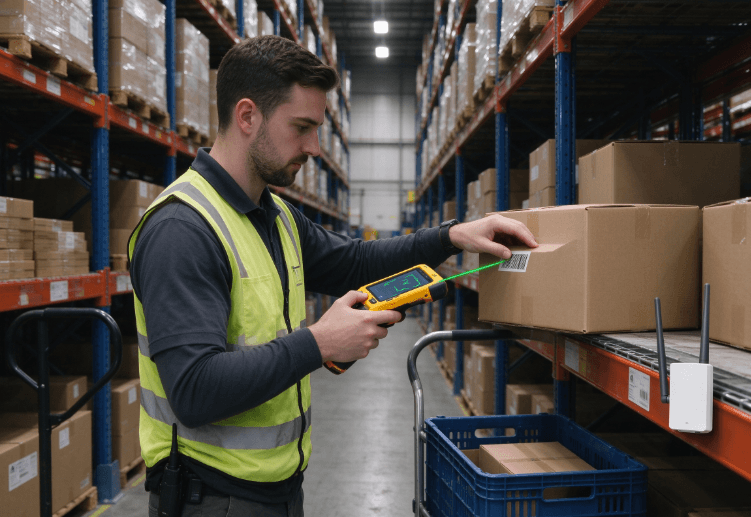
An RFID handheld reader vs barcode scanner comparison comes down to three factors: how many items must be identified, whether their labels are visible, and the total cost of capturing accurate data. RFID can read multiple compatible tags without direct line of sight, making it useful for inventory counting and asset tracking. Barcode scanning usually offers a simpler, less expensive approach when employees need to identify individual items precisely.
Neither technology is universally better. A warehouse counting hundreds of tagged garments has different requirements from a technician scanning a serial number on one replacement component.
The practical choice depends on item characteristics, scanning conditions, software integration, and the volume of transactions.
How Do RFID Handheld Readers and Barcode Scanners Work?
A barcode scanner uses an optical sensor to capture information encoded in a printed symbol. Most handheld scanners read one targeted barcode at a time, although imaging systems can support other capture workflows.
A UHF RFID handheld reader communicates with electronic tags using radio waves. Compatible passive tags receive energy from the reader and transmit their stored identification data.
Unlike barcode scanning, RFID does not normally require direct visual alignment between the reader and tag.
GS1 identifies passive UHF RFID, often called RAIN RFID, as a widely used technology for item-level identification and supply chain applications.
RFID vs Barcode: Key Differences
| Feature | RFID Handheld Reader | Barcode Scanner |
|---|---|---|
| Reading method | Radio frequency | Optical scanning |
| Direct line of sight | Usually unnecessary | Generally required |
| Multiple-item reading | Supported with compatible tags | Typically one targeted barcode at a time |
| Identification | Often unique item-level EPC | Product, batch, or serial data depending on encoding |
| Label cost | Electronic RFID tag | Printed barcode |
| Metal and liquid sensitivity | Can significantly affect UHF performance | Primarily depends on label visibility and condition |
| System complexity | Reader settings, tag encoding, read-zone management | Barcode decoding and application integration |
| Typical applications | Bulk inventory, asset tracking, item movement | Checkout, receiving, shipping, individual verification |
These differences explain why RFID is attractive for high-volume inventory work, while barcodes remain practical for controlled transactions.
Scanning Speed: When Does RFID Actually Save Time?
RFID’s main advantage is not simply a faster individual read. It is the ability to identify multiple tagged items during a single reading operation.
For example, a retail employee may scan individual garment labels using a barcode scanner. With appropriately tagged merchandise, an RFID reader can collect multiple identifiers while the employee moves along a shelf.
This can reduce the time spent locating and scanning individual labels.
However, the number of tags detected is not necessarily the number of correct inventory transactions.
Read Rate vs. Inventory Accuracy
RFID reader specifications sometimes advertise high tag-reading rates.
These figures describe the reader’s data-capture capability under particular conditions. They do not guarantee equivalent inventory counting performance.
Actual results depend on:
- Tag orientation and antenna design.
- Reader antenna characteristics and output power.
- Distance between reader and tags.
- Number of tags within the reading area.
- Metal, liquids, and surrounding structures.
- Application filtering and duplicate-read handling.
A reader may detect the same tag repeatedly while an operator moves through a storage area.
Software must distinguish repeated observations from unique items. It must also prevent tags outside the intended counting area from entering the inventory result.
The RAIN Alliance provides technical guidance on managing reading zones and avoiding unintended tag detection.
When Barcode Scanning Remains Faster
Barcode scanning may be more efficient when workers must identify one specific item and immediately confirm its transaction.
Consider a repair technician selecting a replacement motor from a storage shelf.
A barcode scanner can capture the exact visible label, while the application confirms the part number and storage location.
RFID could identify nearby tagged objects, but additional software filtering may be required to isolate the intended item.
For operations involving single-item verification, direct optical scanning can provide a straightforward workflow without requiring electronic tags.
RFID Tag Types, Metal Interference and Read Reliability
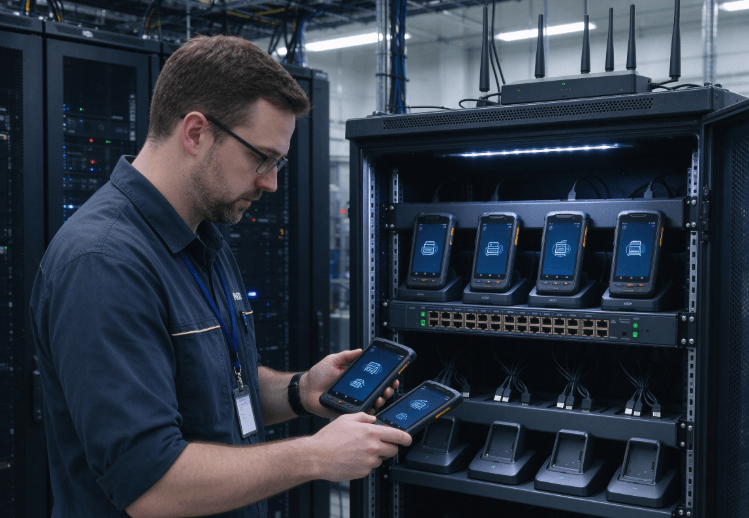
RFID performance depends heavily on the tag, not just the handheld reader.
Passive UHF tags contain a chip and antenna. Their physical construction, placement, and surrounding materials affect how efficiently they receive and transmit radio-frequency energy.
A standard paper-label RFID inlay may perform well on cardboard but poorly when attached directly to metal equipment.
Why Metal and Liquids Cause Problems
Metal can reflect radio-frequency signals and alter an RFID antenna’s electrical characteristics.
Liquids, particularly water-rich materials, can absorb UHF energy and reduce the energy available to power a passive tag.
These effects may reduce read range or create inconsistent detection.
Specialized on-metal tags use designs intended to operate near conductive surfaces. Tags used on liquid containers may also require careful antenna selection and placement.
GS1 explains these limitations in its guidance on RFID performance around metal and water.
Choosing the Appropriate Tag
| Tagged Item | RFID Consideration |
|---|---|
| Apparel and textiles | Flexible, lightweight UHF inlays |
| Cardboard cartons | Label-based passive UHF tags |
| Metal tools and machinery | On-metal RFID tags |
| Reusable containers | Durable tags suited to cleaning and handling |
| Liquid-filled packaging | Application-specific tag placement and testing |
Tag durability also matters.
A tag exposed to abrasion, heat, chemicals, or repeated washing may need a different enclosure or attachment method from a disposable shipping label.
For barcodes, the equivalent concerns involve printing quality, label damage, contrast, and scanner compatibility.
Neither technology eliminates the need for appropriate labeling and maintenance.
Total Cost: RFID Tags vs Printed Barcodes
Barcode systems generally have lower labeling costs because they use printed symbols rather than electronic components.
RFID adds the cost of tags, encoding, compatible readers, and potentially more complex software integration.
However, equipment price and tag price alone do not determine the economic outcome.
What Contributes to RFID System Cost?
A typical RFID deployment may include:
- Handheld readers or fixed reading equipment.
- RFID tags selected for the products.
- Tag printing and encoding.
- Application integration with WMS or ERP systems.
- Read-zone configuration and testing.
- Employee training and operational support.
A barcode deployment also requires scanners, labels, software integration, and maintenance. Existing barcode infrastructure may reduce additional implementation work.
Example: Comparing Inventory Counting Costs
Consider a warehouse performing frequent inventory counts.
Assume barcode counting requires 12 labor hours per cycle, while a validated RFID workflow requires four hours.
At an illustrative labor rate of $20 per hour:
- Barcode counting labor: $240 per cycle.
- RFID counting labor: $80 per cycle.
- Potential labor difference: $160 per cycle.
If the warehouse performs 50 counts annually, the illustrative annual labor difference is $8,000.
These figures are hypothetical. They exclude tag costs, reader investment, software integration, exception handling, and equipment maintenance.
The calculation should not be interpreted as a guaranteed return on investment.
The more useful comparison is the total cost of producing an accurate inventory record.
Why Tag Cost Changes the Business Case
RFID may be attractive for reusable assets because the same tag can remain attached throughout many operating cycles.
For disposable packaging, tag expenditure repeats with every item.
A business shipping low-value products in large volumes may find barcode labels more economical.
An operation managing reusable tools or high-value assets may benefit from automated identification and reduced manual counting.
The decision depends on how frequently items are scanned and how much labor or error correction the technology can realistically eliminate.
Which Technology Fits Warehouse and Industrial Applications?
The correct solution becomes clearer when the comparison is linked to actual workflows.
Warehouse Inventory Counting
RFID is particularly useful when employees need to identify many tagged items across shelves, containers, or storage locations.
A handheld reader can collect identifiers while the operator moves through the inventory area.
Kroniix’s associated product range includes the R366C-S UHF RFID handheld terminal, which belongs to its long-range RFID product category.
For a warehouse application, evaluate its regional frequency configuration, antenna characteristics, software interface, and performance with the intended tags.
Manufacturing and Tool Tracking
Manufacturing facilities often track tools, fixtures, maintenance equipment, and work-in-progress materials.
RFID can be useful when assets circulate repeatedly and require individual identification without direct access to their labels.
The R366A-S RFID handheld terminal is another device to consider when evaluating this type of mobile identification workflow.
For metal tools, specialized tags and representative read tests are particularly important.
Barcode scanning may remain suitable when workers inspect one component at a time and need deliberate confirmation of its identity.
Retail Stocktaking and Shipping Verification
Retail inventory counting can benefit from RFID when merchandise is already tagged consistently.
Workers may count many products without individually locating every printed barcode.
Shipping verification is different.
A shipping operator may need to confirm that a specific carton matches an order. A barcode can provide direct identification with relatively simple equipment.
Some operations use RFID for stock visibility and barcodes for final transaction verification.
Evaluating Handheld Hardware
Kroniix’s product catalog separates ordinary handheld terminals from UHF RFID models.
For example, the R366-S handheld terminal appears in the standard handheld category, while the M1 appears in the UHF RFID category.
These distinctions help identify the appropriate product family, but the complete specifications must determine actual suitability.
Confirm barcode engine options, RFID frequency bands, antenna performance, software compatibility, and battery requirements for each selected configuration.
How to Test RFID and Barcode Performance Before Deployment
A useful comparison should reproduce the same inventory or identification task using both technologies.
The objective is to measure completed, accurate transactions rather than the maximum number of theoretical reads.
A practical evaluation involves:
- Selecting representative products and labels.
- Defining the correct inventory count.
- Testing barcode scanning under normal operating conditions.
- Testing RFID using appropriate tags and reader settings.
- Recording missed items, duplicate reads, and unintended detections.
- Measuring total operator time, including error correction.
- Comparing labor, labeling, integration, and maintenance requirements.
For RFID, test metal shelving, dense product arrangements, and nearby tagged inventory.
For barcode scanning, include damaged labels, awkward reading angles, and realistic scanning distances.
The results should identify where one technology improves the workflow and where it introduces additional complexity.
Conclusion
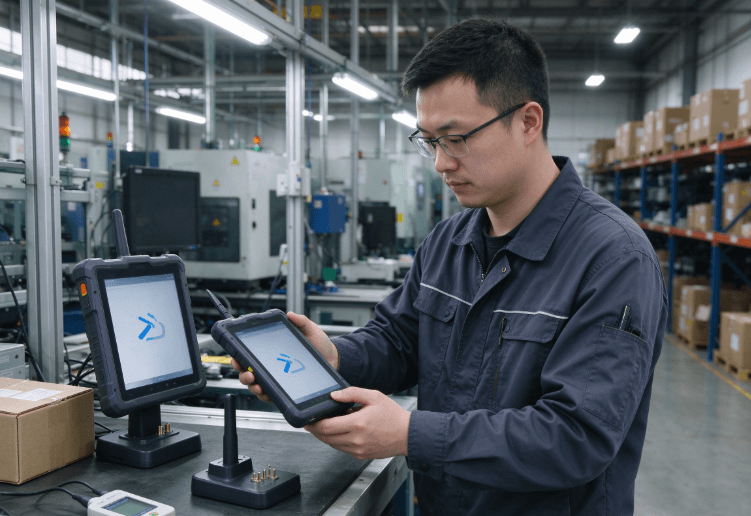
An RFID handheld reader can reduce manual scanning effort when businesses need to identify many properly tagged items. A barcode scanner remains a practical choice for individual item verification and operations with established printed-label systems.
RFID’s advantages depend on tag selection, read-zone control, environmental conditions, and software accuracy. Its additional hardware and labeling costs should be compared against measurable operational savings.
For many industrial and warehouse applications, RFID and barcode scanning serve complementary roles rather than competing as universal replacements.
The appropriate decision is the one that produces accurate identification with the least operational complexity and acceptable total cost.
FAQ
Is RFID faster than barcode scanning?
RFID can identify multiple compatible tags during one reading operation, potentially reducing counting time. Actual productivity depends on tag quality, interference, software filtering, and workflow design.
Can RFID read through cardboard boxes?
Passive UHF RFID can often read compatible tags through cardboard without direct line of sight. Performance depends on the contents, tag placement, antenna orientation, and reading distance.
Why does RFID sometimes fail near metal?
Metal can reflect radio signals and detune conventional RFID tag antennas. Specialized on-metal tags and suitable placement can improve performance.
Are RFID tags more expensive than barcodes?
Generally, yes. RFID tags contain electronic components, while barcode labels can be printed using conventional labeling equipment. Total cost also depends on labor, equipment, and integration.
Can an RFID handheld reader scan barcodes?
Some RFID handheld terminals also include barcode scanning hardware. However, dual-function capability must be confirmed for the exact model and configuration.
Should a warehouse replace all barcode scanners with RFID readers?
Not necessarily. RFID is useful for bulk inventory and asset identification, while barcode scanners remain effective for individual verification. Many operations benefit from using both technologies.