

Custom Industrial Tablet Solutions: An Engineering & Sourcing Guide


The transition from consumer-grade mobile devices to dedicated industrial hardware represents a pivotal shift in enterprise digital transformation. While a standard tablet might suffice for a retail POS, the rigorous demands of a smart factory, a chemical processing plant, or a remote construction site require a “custom industrial tablet” designed for survivability and specific functional integration.
Choosing a custom solution is not merely about choosing a faster processor; it is about engineering a tool that fits into a complex ecosystem of legacy hardware, specialized software, and harsh environmental variables. For project managers and procurement heads, understanding the technical nuances of these devices is the difference between a successful rollout and a costly hardware failure within six months.
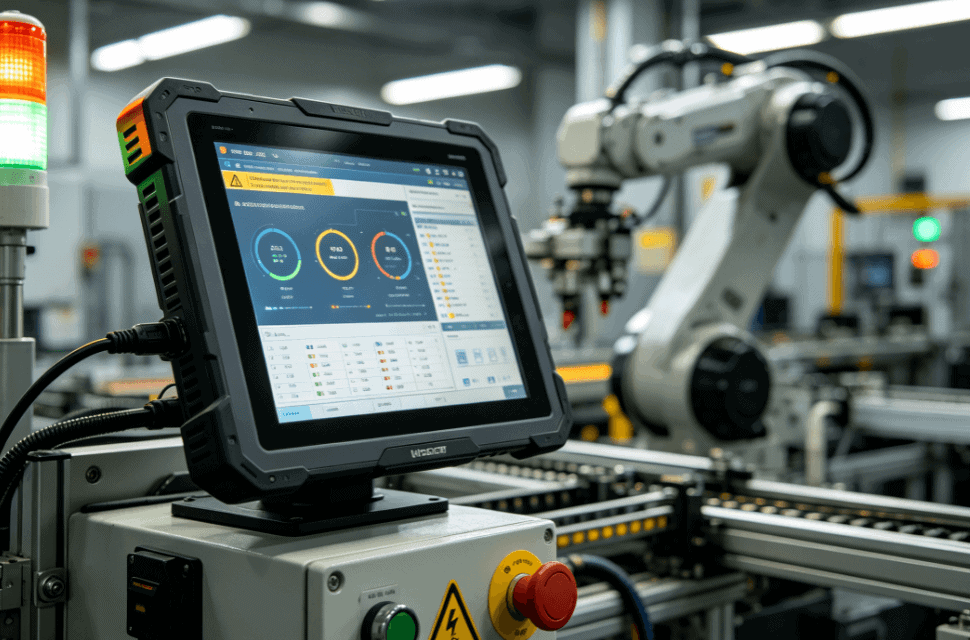
Engineering for Environment: Beyond the “Rugged” Label
In the industrial sector, “rugged” is a broad term that requires precise quantification. When sourcing a custom industrial tablet, the first point of evaluation is the environmental envelope in which the device will operate.
Ingress Protection (IP) and Sealing
Standard consumer tablets often lack meaningful IP ratings. A professional industrial solution typically begins at IP65 (dust-tight and protected against water jets) and moves to IP67 or IP68 for environments involving total immersion or heavy high-pressure washdowns, common in food processing or pharmaceutical manufacturing.
Thermal Management
Commercial tablets rely on thin chassis designs that throttle CPU performance when temperatures rise. Custom industrial tablets utilize passive cooling systems—often incorporating magnesium alloy chassis that act as heat sinks—allowing the device to maintain 100% CPU load in ambient temperatures exceeding 50°C (122°F) without thermal shutdown.
Impact and Vibration Resistance
For vehicle-mounted applications or field service, the MIL-STD-810H standard is the benchmark. This involves testing for altitude, shock, and specific vibration frequencies found in heavy machinery. A custom solution might include reinforced internal connectors and “optical bonding” for the display, which eliminates the air gap between the glass and the LCD, significantly increasing impact resistance and reducing parallax errors.
The Logic of Custom I/O and Peripheral Integration
The primary reason businesses seek a “custom industrial tablet” over an off-the-shelf rugged device is the need for specific connectivity. Modern industrial workflows often require a bridge between mobile software and physical infrastructure.
Customization typically falls into three categories:
- Legacy Ports: While the world has moved to USB-C, industrial automation still relies on RS232, RS485, and DB9 serial ports. Custom builds allow for the integration of these ports directly into the tablet chassis, eliminating the need for unreliable dongles.
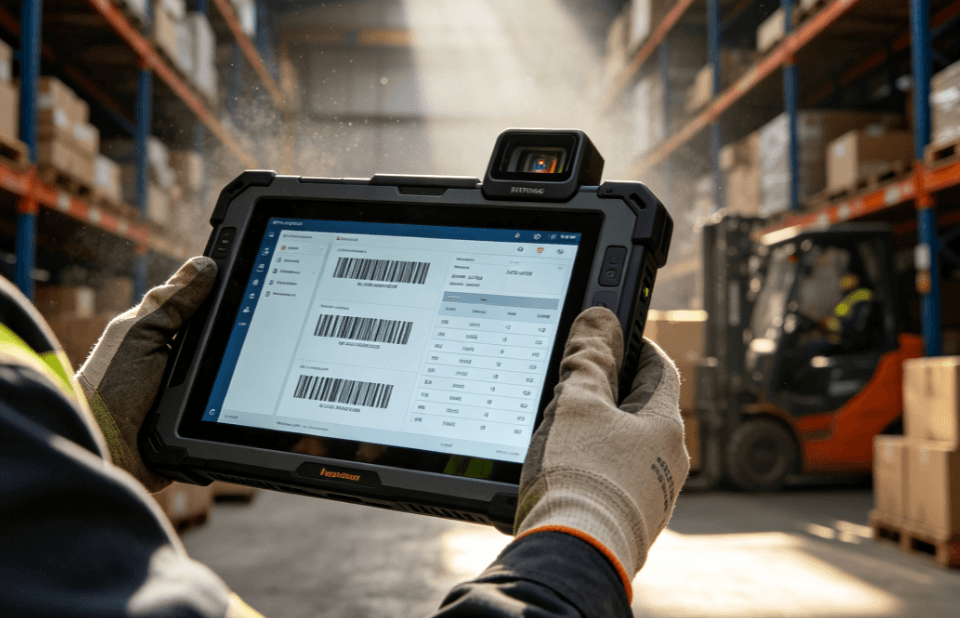
- Data Capture Modules: High-performance 1D/2D barcode scanners, RFID/NFC readers (HF, UHF), and even biometric sensors can be integrated into the housing. This is critical for warehouse management where “point-and-shoot” ergonomics drastically improve scanning speed.
- Modular Expansion: Some platforms, such as those offered by Industrial Tablet PC, utilize expansion “backs” or “caps” that allow businesses to swap modules (e.g., adding a thermal camera or a specialized RJ45 LAN port) without replacing the entire tablet.
Display Technology: Readability in Extremes
A common failure point for mobile deployments is poor visibility in outdoor or high-glare environments. A custom industrial tablet addresses this through two primary technical pathways:
- High-Nits Backlighting: Standard tablets average 300-400 nits. Industrial versions often scale to 1,000+ nits to ensure sunlight readability.
- Touchscreen Optimization: Custom firmware allows the capacitive or resistive touchscreens to be tuned for “Glove Mode” or “Wet Tracking.” In many manufacturing or cold-storage environments, workers cannot remove PPE to interact with a screen; a custom-tuned controller ensures the device distinguishes between a deliberate finger press and a stray water droplet.
OS Stability and Lifecycle Management
One of the most overlooked aspects of industrial sourcing is the software lifecycle. Consumer tablets have a “market life” of 12-24 months, after which parts become unavailable and OS updates may break proprietary applications.
Enterprise Lifecycle Support:
A professional custom industrial tablet manufacturer typically guarantees a 3-to-5-year production lifecycle with an additional 5 years of repair support. This “Long-Term Servicing Channel” (LTSC) approach, particularly with Windows 10/11 IoT Enterprise or specific Android builds, ensures that the software environment remains “frozen” and stable, preventing forced updates that could jeopardize mission-critical operations.
Total Cost of Ownership (TCO) Comparison
| Feature | Consumer Tablet + Rugged Case | Custom Industrial Tablet |
| Initial Cost | Low ($400 – $800) | High ($1,200 – $3,000) |
| Failure Rate (Annual) | 15% – 30% | < 3% |
| Lifecycle | 12 – 18 Months | 5 – 7 Years |
| I/O Options | Restricted (USB only) | Modular (Serial, LAN, RFID) |
| Battery | Internal (Non-swappable) | Hot-swappable (24/7 uptime) |
While the upfront cost of a custom solution is higher, the TCO over three years is significantly lower. The costs associated with downtime, IT re-imaging, and frequent hardware replacement for “fragile” devices far outweigh the initial investment in industrial-grade hardware.
Strategic Sourcing: Evaluating a Custom Partner
When moving toward a BOFU (Bottom of Funnel) decision, the evaluation should shift from specs to manufacturing capability. A reliable partner like Industrial Tablet PC should be vetted based on:
- Certification Compliance: Can the manufacturer provide documentation for CE, FCC, or ATEX/IECEx (for explosive environments)?
- Prototyping Speed: How quickly can a custom I/O configuration be mocked up or sampled?
- Supply Chain Transparency: In the current semiconductor climate, does the supplier have a strategy for mitigating component obsolescence?
- Custom Branding (OEM): For businesses reselling the tablet as part of a larger machine solution, the ability to apply custom logos, colors, and BIOS splash screens is essential for brand consistency.
Conclusion
Custom industrial tablet solutions are not a commodity; they are a strategic asset. By focusing on environmental resilience, modular connectivity, and long-term support cycles, businesses can ensure that their mobile workforce is equipped with tools that enhance—rather than hinder—operational efficiency. Whether it is for field data collection or on-floor manufacturing execution systems (MES), the “custom” element ensures the technology adapts to the worker, not the other way around.
FAQ
What is the typical MOQ for a custom industrial tablet?
MOQs (Minimum Order Quantities) vary significantly. While standard rugged tablets can often be purchased individually, “deep” hardware customizations (like a unique chassis mold) may require 100–500 units. However, many suppliers offer modular customization (e.g., adding an RFID module) for much smaller batches.
Can industrial tablets run proprietary legacy software?
Yes. This is a primary driver for custom solutions. Most industrial tablets support Windows 10/11 IoT Enterprise, which provides full x86 compatibility for legacy .NET or Java-based industrial applications that cannot run on mobile OS versions.
How does “Hot-Swappable Battery” technology work?
A custom industrial tablet with a hot-swap feature contains a small internal “bridge battery.” This provides 5–10 minutes of power, allowing the user to swap the main depleted battery for a fresh one without shutting down the OS or losing data, enabling 24/7 continuous operation.
Are custom tablets available for hazardous locations (Oil & Gas)?
Yes. You must specify the need for C1D2 (Class 1 Division 2) or ATEX Zone 1/2 certifications during the RFQ process. This involves specialized sealing and non-sparking electrical components to prevent ignition in volatile atmospheres.
Reference Sources
- IEEE Xplore: Standards for Industrial Electronic Equipment
- MIL-STD-810H: Department of Defense Test Method Standard for Environmental Engineering Considerations
- International Electrotechnical Commission (IEC): IP Code (Ingress Protection) Explained
- Microsoft Learn: Windows IoT Enterprise LTSC Overview