

Rugged Tablets in Field Service: Optimizing Mobile Workflows

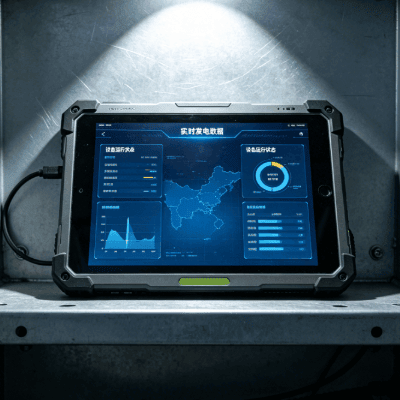
Field service operations have moved far beyond manual paper logs and basic digital entry. In modern utilities, telecommunications, and industrial maintenance, the mobile device is the primary interface between the technician and the enterprise resource planning (ERP) system. However, the environments these technicians inhabit—construction sites, offshore rigs, and remote substations—are inherently hostile to standard consumer electronics.
A field service rugged tablet is not merely a “tougher” version of a consumer iPad; it is a precision-engineered industrial tool designed to maintain uptime where standard hardware fails. Understanding the technical architecture and operational role of these devices is essential for any organization looking to digitize its field workforce effectively.
What Defines a Tablet as “Rugged” for Field Service?
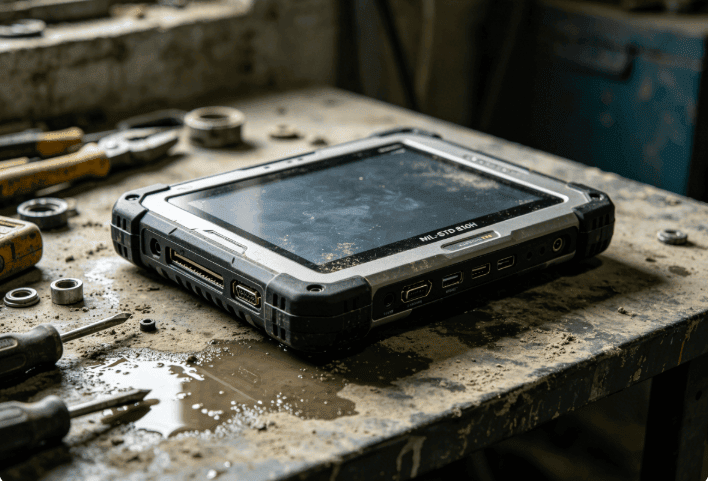
In an industrial context, “ruggedness” is defined by adherence to specific engineering standards rather than marketing claims. Field service operations require hardware that can survive environmental stressors that would immediately compromise a consumer-grade device.
1. MIL-STD-810H Compliance
The United States Military Standard (MIL-STD-810H) is the benchmark for ruggedized equipment. It involves a series of laboratory tests that simulate the effects of environmental stress. For a tablet to be effective in field service, it must pass tests for:
- Transit Drop: Surviving multiple drops from heights of 4 to 6 feet onto concrete.
- Vibration: Withstanding the constant mechanical oscillation found in service vehicles or near heavy machinery.
- Thermal Shock: Functioning during rapid temperature transitions, such as moving from a climate-controlled vehicle to a -20°C outdoor site.
2. Ingress Protection (IP) Ratings
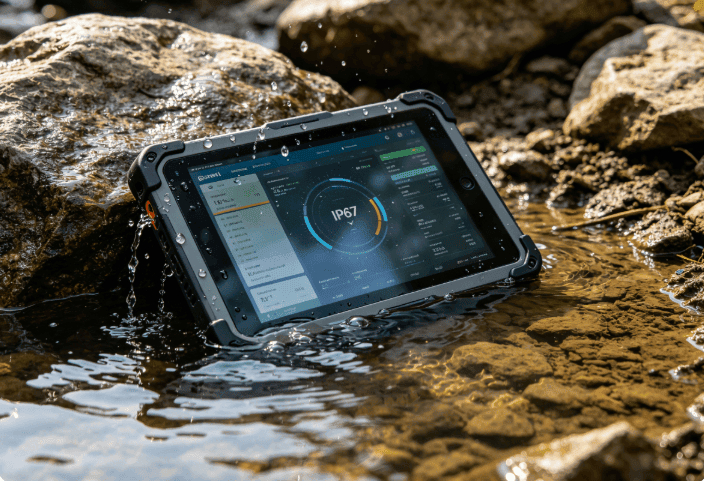
The IP rating determines a device’s resistance to solids and liquids. Most high-tier rugged tablets carry an IP65 or IP67 rating.
- IP65: Fully dust-tight and protected against water jets from any angle.
- IP67: Fully dust-tight and capable of surviving immersion in water up to 1 meter for 30 minutes.
For field technicians working in heavy rain or dusty environments, these ratings are the difference between a completed work order and a costly hardware replacement.
Core Technical Requirements for Field Operations
Beyond physical durability, the internal components and interface must be optimized for field-specific workflows.
Sunlight-Readable Displays
Standard tablets typically offer 300–400 nits of brightness, which becomes illegible under direct sunlight. Industrial rugged tablets utilize high-nit displays (typically 800–1000+ nits) and optical bonding technology to reduce glare and internal reflection. This allows a technician to view complex electrical schematics or GIS maps without seeking shade.
Advanced Connectivity Modules
Field service often occurs on the “edge” of the network. Rugged tablets integrate specialized communication modules that outperform consumer hardware:
- Dedicated GPS: High-precision GNSS (Global Navigation Satellite System) modules for accurate asset tagging and location-based service tracking.
- 4G/5G LTE & CBRS: Ensuring persistent data links in areas with weak Wi-Fi coverage.
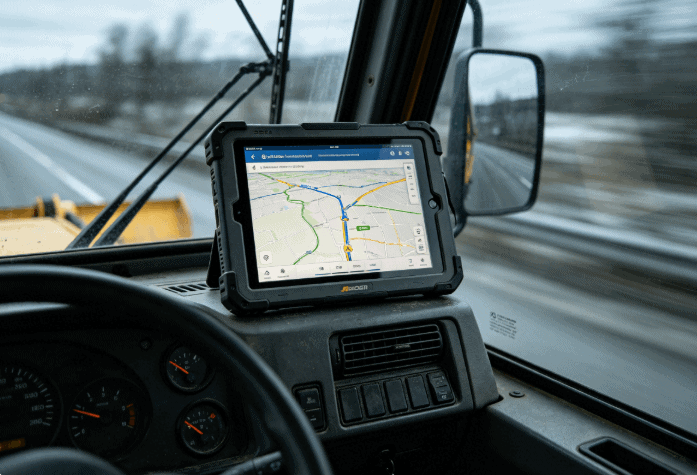
- External Antenna Pass-through: Allowing the tablet to connect to vehicle-mounted high-gain antennas for improved signal strength in remote regions.
Specialized Data Capture
In field service, the tablet acts as a data gateway. Integrated tools like 1D/2D hardware barcode scanners, NFC readers, and high-resolution cameras with LED flashes enable technicians to inventory parts, verify assets, and document site conditions with a single device.
| Feature | Consumer Tablet | Rugged Tablet (Field Grade) |
|---|---|---|
| Drop Resistance | Minimal (requires case) | 4-6 Feet (Integrated) |
| Battery Life | 8-10 Hours (Fixed) | 12-20 Hours (Hot-Swappable) |
| Touch Interface | Capacitive (Fails when wet) | Rain/Glove Mode Capacitive |
| Operating Temp | 0°C to 35°C | -20°C to 60°C |
| I/O Ports | USB-C only | Serial (RS232), RJ45, USB 3.0 |
Impact on Field Service Workflows
The implementation of rugged tablets changes the fundamental “day-in-the-life” of a field engineer.
1. Real-Time Remote Diagnostics
Technicians can utilize the tablet’s high-bandwidth connectivity to initiate video calls with remote specialists. By sharing a live high-definition feed of a malfunctioning component, the technician can receive expert guidance, reducing the need for “truck rolls” (repeat visits) and improving First-Time Fix Rates (FTFR, the percentage of service issues resolved on the first visit).
2. GIS and Asset Management
For utilities and telecommunications, precise location data is critical. Rugged tablets allow field crews to access Geographic Information System (GIS) layers in real-time. This ensures they are excavating in the correct location or identifying the exact transformer that requires maintenance, significantly reducing operational risk.
3. Digital Documentation and Compliance
In regulated industries like oil and gas, safety inspections and compliance logs must be timestamped and verifiable. A rugged tablet allows for immediate digital entry, often including biometric or NFC-based technician verification, ensuring that data is not lost or altered between the field and the office.
Total Cost of Ownership (TCO) Perspective
From an engineering and procurement standpoint, the initial acquisition cost of a field service rugged tablet is higher than a consumer alternative. However, the Total Cost of Ownership (TCO) is significantly lower over a 3-to-5-year lifecycle.
Consumer devices in field service typically experience failure rates of 15% to 30% per year due to cracked screens, moisture ingress, or port failure. When a device fails in the field, the cost is not just the replacement hardware; it includes:
- Technician downtime (lost labor hours).
- Travel costs for returning to the depot.
- IT overhead for re-provisioning.
- Potential penalties for missed Service Level Agreements (SLAs).
Rugged tablets, built with industrial-grade thermal management and reinforced chassis, typically see failure rates below 5%, ensuring that the mobile workforce remains productive regardless of environmental conditions.
Integration with Modern Ecosystems
Modern rugged tablets are designed to bridge the gap between legacy industrial hardware and cloud-based software. With support for Windows 11 Pro or Android Enterprise, these devices run the same mission-critical applications—such as SAP Field Service Management, Salesforce Field Service, or Microsoft Dynamics 365—found in the headquarters.
The presence of legacy ports like RS232 (Serial) or dedicated Ethernet (RJ45) allows field service professionals to interface directly with older PLC (Programmable Logic Controller) systems or network switches, a capability that has been entirely phased out of the consumer market.
FAQ
Can I just use a rugged case on a standard tablet for field service?
While a rugged case provides some impact protection, it does not address internal thermal management, sunlight readability, or port durability. Consumer tablets often overheat inside a rugged case when used outdoors, and their internal components are not designed to handle the constant vibration of a service vehicle.
What is the benefit of a “hot-swappable” battery?
In field service, a shift may last longer than 8 hours, or a tablet may be used across multiple shifts. A hot-swappable battery allows the user to replace a depleted battery with a charged one without powering down the device, ensuring zero data loss and continuous workflow.
Are rugged tablets too heavy for all-day use?
Modern engineering has significantly reduced the weight of rugged devices. Many 10-inch rugged tablets now weigh under 2.5 lbs (1.1 kg) and feature ergonomic handles or shoulder straps designed specifically for technicians who need to keep their hands free for tools.
Do rugged tablets support gloved or wet-weather use?
Yes. Industrial tablets use specialized touch controllers that can be toggled between “Glove Mode” (increased sensitivity) and “Rain Mode” (rejecting false touches from water droplets).
Reference Sources:
- MIL-STD-810H Standards: Department of Defense Test Method Standard: Environmental Engineering Considerations and Laboratory Tests.
- IEC 60529: Degrees of protection provided by enclosures (IP Code).
- VDC Research: The Total Cost of Ownership of Mobile Devices in Enterprise Environments.