
UHF RFID Handheld Reader Manufacturer: What OEM Buyers Should Check


Choosing a reliable UHF RFID handheld reader manufacturer requires evaluating RF performance, antenna design, software integration, manufacturing consistency, regional compliance, and long-term technical support. OEM buyers should verify reading distance under realistic conditions, confirm SDK compatibility, review available customization options, and test production samples before placing bulk orders.
For distributors, system integrators, and enterprise procurement teams, the lowest unit price rarely determines the best long-term value. A reader that performs well in a laboratory may struggle with metal shelving, liquid-filled products, or a warehouse management application that cannot process repeated tag observations.
A structured supplier evaluation helps buyers identify these limitations before committing to inventory, software development, or customer deployment.
1. What Does a UHF RFID Handheld Reader Manufacturer Provide?
A UHF RFID handheld reader is a portable computing device that uses radio-frequency communication to identify compatible electronic tags.
Most industrial handheld readers operate with passive UHF RFID tags. The reader transmits energy, receives backscattered tag responses, and passes the captured identifiers to software.
A complete industrial RFID handheld typically combines several components:
- UHF RFID radio module.
- Reader antenna and RF circuitry.
- Android or another supported computing platform.
- Display, buttons, and scanning controls.
- Battery and charging system.
- Wi-Fi, Bluetooth, and optional cellular connectivity.
- RFID software interfaces.
- Mechanical housing and industrial accessories.
Manufacturers may design these systems internally or integrate modules supplied by specialist component manufacturers.
Consequently, OEM buyers should establish which parts of the system their supplier actually designs, produces, configures, and supports.
Manufacturer vs. OEM Supplier vs. ODM Partner
| Supplier Type | Typical Responsibility | Main Purchasing Question |
|---|---|---|
| Original manufacturer | Product production and quality control | Who controls manufacturing and testing? |
| OEM supplier | Standard products with agreed specifications or branding | Which changes can be made without redesign? |
| ODM partner | Product or subsystem design and development | Who owns the engineering work and design files? |
| Distributor | Product sourcing and resale | Who provides firmware and warranty support? |
| System integrator | Hardware and software deployment | Who resolves compatibility and integration issues? |
These roles can overlap.
A supplier may manufacture standard RFID readers while providing limited customization services.
However, a company offering private-label packaging does not necessarily control its RFID radio design or Android firmware.
OEM buyers should clarify these responsibilities before discussing custom configurations.
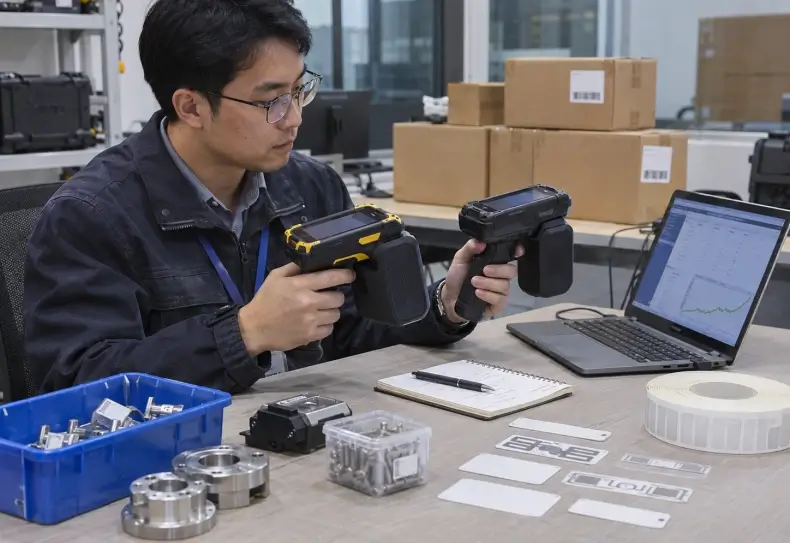
2. Evaluate RFID Reading Performance Under Real Conditions
Reading distance and tag throughput are important purchasing criteria, but manufacturer specifications require context.
A handheld reader’s practical performance depends on its RFID module, antenna, tag sensitivity, RF output settings, and surrounding materials.
Reading Distance: What Does the Maximum Range Mean?
Manufacturers may publish a maximum reading distance achieved with a particular reference tag.
That result can be useful for initial comparisons, but it does not establish performance across every warehouse environment.
Factors affecting read range include:
- RFID tag size and antenna design.
- Tag orientation.
- Reader antenna gain and polarization.
- Transmit power.
- Regional frequency settings.
- Metal structures and liquid-rich materials.
- Interference from nearby systems.
- Operator position and movement.
For instance, a large reference tag on a cardboard carton may read much farther away than a compact tag mounted on a steel tool.
Buyers should request the tag model, testing distance, RF configuration, and environmental conditions associated with any published range claim.
Multi-Tag Reading Speed and Inventory Accuracy
A supplier may advertise hundreds or thousands of tag reads per second.
However, the reported rate does not necessarily represent the number of unique assets that employees can accurately identify in a production workflow.
A reader can detect the same EPC repeatedly during one session.
Therefore, evaluate both raw reading performance and application-level results.
| Test Metric | What It Measures |
|---|---|
| Maximum read distance | Furthest detection under defined conditions |
| Reliable working distance | Repeatable detection at the required range |
| Tag read rate | Volume of radio observations |
| Unique EPC capture rate | Number of distinct tags detected |
| Inventory completeness | Percentage of expected tags found |
| Unintended reads | Tags captured outside the target group |
| Time to complete a task | Overall operational productivity |
A reader that captures large volumes of unintended tags may require more filtering than a device with a carefully controlled read zone.
The correct goal is reliable identification of the intended inventory, not the highest possible raw read count.
Compare Antenna Configurations
Antenna polarization influences communication with tag antennas.
Linear polarization can provide efficient coupling when the reader and tag orientations align.
Circular polarization generally reduces sensitivity to variations in tag orientation.
Neither configuration is automatically superior for every task.
For handheld warehouse inspections, tag direction may change constantly. For controlled industrial stations, operators may approach tags from predictable positions.
OEM buyers should request antenna gain, polarization, radiation-pattern information, and the relevant field test results.
For industrial assets installed on steel structures, read performance also depends on tag design and mounting conditions. The UHF RFID metal interference guide explains how nearby metal affects tag antennas and practical reading distance.
3. Compare RFID Handheld Product Configurations
A manufacturer’s product range can reveal whether it offers different RFID reading architectures for different applications.
Seaview lists the R366C-S and R366A-S within its industrial RFID handheld portfolio.
R366C-S: Higher-Range Inventory Applications
The R366C-S UHF RFID handheld reader uses an Impinj E710 RFID module.
Its published specifications include:
| Specification | R366C-S |
|---|---|
| Operating system | Android 13 |
| RFID module | Impinj E710 |
| RFID protocol | EPC Class 1 Gen 2 / ISO 18000-6C |
| Antenna | 4 dBi in the published range configuration |
| Nominal reading distance | Up to 10m |
| Published reading rate | At least 900 tags/s |
| Battery | 10,000mAh detachable |
| Display | 5.5-inch HD+ |
This configuration provides a starting point for evaluating bulk inventory counting, asset inspection, and warehouse RFID workflows.
However, the maximum range and throughput figures are specification values rather than guaranteed field results.
Buyers should validate the device with their own RFID tags and software.
R366A-S: Compact RFID Data Collection
The R366A-S RFID handheld terminal uses an integrated 40×40mm ceramic UHF RFID module.
Its published specifications include Android 13, a detachable 5700mAh battery, and a nominal RFID reading distance of up to 2m.
The R366A-S may be relevant for applications requiring shorter reading distances and a compact handheld configuration.
Examples include controlled asset identification, equipment verification, and targeted data collection.
The appropriate choice depends on the required read zone and operator workflow.
Product Configuration Comparison
| Evaluation Factor | R366C-S | R366A-S |
|---|---|---|
| RFID approach | Impinj E710 module | Integrated ceramic module |
| Published range | Up to 10m | Up to 2m |
| Battery | 10,000mAh | 5700mAh |
| Operating system | Android 13 | Android 13 |
| Main evaluation focus | Bulk or longer-distance reading | Shorter-range identification |
| Before ordering | Test read completeness and unintended reads | Test range and tag compatibility |
Both devices belong to Seaview’s UHF RFID handheld terminal product range.
The product pages do not establish that every possible OEM modification, SDK feature, or enterprise management platform is supported.
Buyers should request the exact configuration and supporting technical documentation.
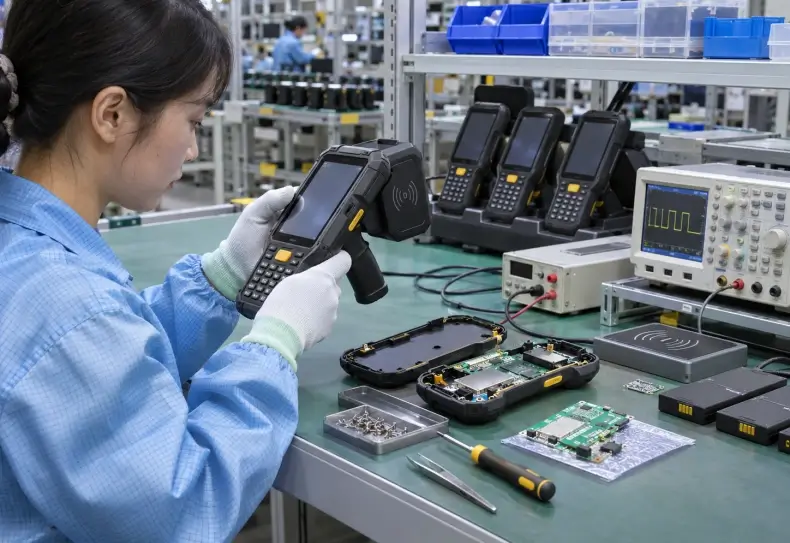
4. RFID Module, Frequency and Protocol Compatibility
A professional RFID manufacturer should explain its radio architecture clearly.
For passive UHF applications, the reader and tags must support compatible air-interface protocols.
EPC Gen2 and ISO/IEC 18000-63
RAIN RFID systems use internationally recognized UHF RFID air-interface standards, including GS1 EPC UHF Gen2 and ISO/IEC 18000-63.
These standards define important aspects of communication between readers and tags.
However, protocol compatibility alone does not guarantee that two products offer the same performance or software interface.
An RFID module may support the required air interface while using different host commands, firmware, or application development tools.
Regional Frequency Requirements
UHF RFID regulations differ by market.
For example, reader configurations may need to support frequency bands associated with FCC, ETSI, or Chinese regulatory requirements.
A device configured for one market should not be assumed legal for use in another.
Buyers should verify:
- Operating frequency range.
- Allowed regional channels.
- Transmit power configuration.
- Antenna gain and applicable power limits.
- Radio certification requirements.
- Country-specific firmware settings.
These checks should take place before manufacturing and shipment.
A later firmware change does not necessarily resolve a hardware or certification mismatch.
5. SDK, Android Support and Enterprise Integration
An RFID handheld is only one part of an operational system.
The reader must work with the customer’s asset management application, warehouse management system, or industrial inspection platform.
For OEM buyers, software compatibility can determine whether a project succeeds.
What Should an RFID SDK Provide?
A suitable software development kit may expose functions such as:
- RFID inventory start and stop.
- EPC and supported tag-memory reading.
- Tag writing where supported.
- Reader output power adjustment.
- Regional configuration.
- Antenna or operating-mode settings.
- Tag filtering.
- Error reporting.
- Device status information.
The available functions depend on the exact module, firmware, and SDK.
Request sample applications and documentation rather than accepting a general statement that an SDK is available.
Android and Device Management
Android version support matters, especially for enterprise deployments involving many devices.
OEM buyers should verify operating system versions, update policy, application compatibility, and the expected firmware support period.
They should also confirm whether the handheld supports the intended mobile device management platform.
A device running Android does not automatically support every enterprise enrollment method or management function.
Integrating RFID with a WMS
RFID applications must convert raw tag observations into validated warehouse transactions.
The software may need to remove repeated EPCs, detect unexpected tags, match identifiers to inventory records, and communicate with the WMS.
For example, reading 50 tags during receiving does not automatically mean the WMS should accept 50 items.
The application must check the expected shipment and confirm the transaction.
A complete pilot should test the workflow from RFID detection through backend confirmation.
For projects involving serialized equipment and reusable industrial assets, the UHF RFID handheld reader asset tracking guide provides additional guidance on tag selection, EPC identification, and inventory workflows.
6. OEM and ODM Customization: What Is Actually Possible?
Customization is often a major reason buyers search for a UHF RFID handheld reader manufacturer rather than a retail reseller.
However, OEM and ODM capabilities vary significantly.
Common OEM Requirements
Potential customization requests include:
- Logo and packaging changes.
- Device configuration options.
- Selected RFID modules or antennas.
- Memory and storage options.
- Regional wireless configurations.
- Preinstalled applications.
- Device provisioning.
- Charging accessories.
- Firmware settings.
These are potential project requirements, not a statement that every manufacturer supports every option.
When Customization Requires Engineering
Changing a device’s antenna, radio module, or housing can affect RF performance.
For example, moving an antenna within the enclosure may alter radiation patterns and interactions with nearby components.
Increasing battery capacity can also affect dimensions, thermal behavior, and mechanical design.
Such changes require engineering review and may trigger additional testing or regulatory work.
Before agreeing to custom development, establish the scope, ownership, development fees, minimum order quantities, and sample approval process.
Questions to Ask an OEM Partner
| Question | Why It Matters |
|---|---|
| Which components can be customized? | Defines development scope |
| Who controls RFID firmware? | Determines maintenance responsibility |
| Is a complete SDK available? | Reduces application integration risk |
| Will customization affect certifications? | Avoids compliance surprises |
| What is the sample approval process? | Establishes an acceptance baseline |
| Who owns custom tooling and software? | Prevents contractual disputes |
| Can replacement units match the approved configuration? | Supports long-term fleet consistency |
A written technical agreement is more useful than an informal promise of flexible customization.
7. Manufacturing Quality Control and Product Testing
Quality assurance should extend beyond checking whether the device powers on.
An industrial RFID handheld contains radio-frequency, computing, mechanical, and battery subsystems that must work together.
What Should a Factory Test?
A representative quality-control procedure may cover:
| Test Area | Recommended Verification |
|---|---|
| RFID module | Communication and tag detection |
| Antenna | Configuration and RF performance |
| Display and touchscreen | Input accuracy and visual inspection |
| Battery and charging | Power and charging behavior |
| Wireless interfaces | Wi-Fi, Bluetooth and cellular options |
| Scan trigger | Mechanical operation and responsiveness |
| USB and connectors | Data and charging connections |
| Enclosure | Assembly quality and seals |
| Firmware | Approved build and configuration |
| Final traceability | Serial number and batch information |
The manufacturer should explain which tests apply to every unit and which are performed on representative samples.
Durability and Environmental Validation
An industrial reader may experience repeated handling, accidental drops, dust, humidity, and temperature changes.
Buyers should request the relevant test methods and results for the exact device model.
For example, IEC 60529 concerns ingress protection testing, while drop resistance requires separate test evidence.
An IP rating does not automatically prove that the device withstands repeated impacts or all chemical exposures.
Consistency Between Samples and Production Units
One of the main sourcing risks is receiving production devices that differ from approved samples.
Potential differences include RFID module versions, antennas, batteries, and firmware.
The purchase agreement should define the approved configuration.
Any significant change should require communication, assessment, and customer approval.
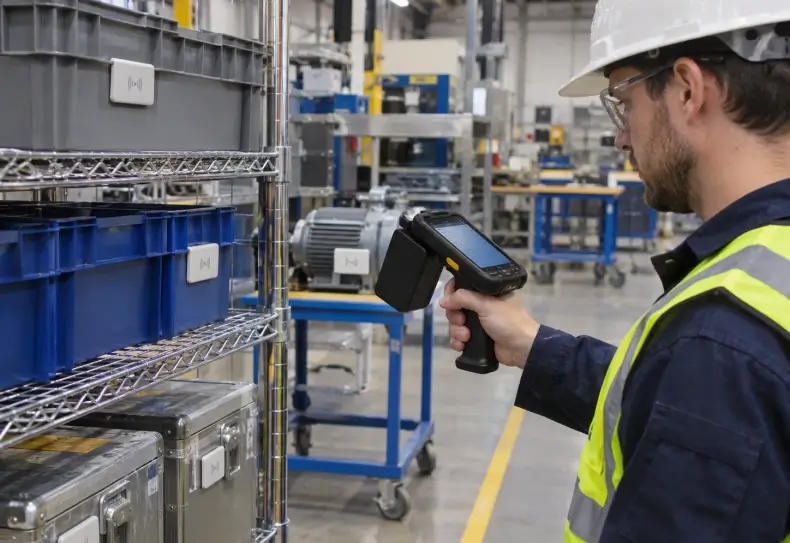
8. Certifications and Export Compliance
RFID readers contain radio transmitters and electronic components.
Their compliance requirements depend on the destination market and exact configuration.
Buyers should request applicable documentation rather than assume that a product sold internationally meets every country’s rules.
Relevant considerations may include:
- FCC equipment authorization for applicable US radio products.
- EU Radio Equipment Directive requirements and supporting CE documentation.
- Applicable ETSI radio standards.
- IEC 62368-1 where relevant to electrical product safety.
- IEC 60529 for claimed ingress protection.
- RoHS requirements.
- UN 38.3 battery transport documentation.
- ISO 9001 certification where the supplier holds a valid certificate.
These documents serve different purposes.
ISO 9001 concerns quality management systems; it does not prove RFID reading performance.
Likewise, compatibility with ISO/IEC 18000-63 does not replace regional radio approvals.
For OEM modifications, confirm whether existing test reports and approvals still apply.
9. Compare Supplier Quotations by Total Project Cost
An RFID reader’s purchase price represents only one part of the project budget.
A lower-cost device may require additional application development, accessory purchases, or technical support.
A practical cost comparison includes:
Total Project Cost = Hardware + Integration + Customization + Accessories + Compliance + Support + Expected Replacement Costs
Factors Affecting OEM Pricing
Important cost drivers include:
- RFID module and antenna configuration.
- Android hardware specifications.
- Battery and charging accessories.
- Order quantity.
- OEM branding.
- Custom firmware or software.
- Required certifications.
- Packaging and logistics.
- Warranty terms.
- Long-term spare parts.
An OEM buyer should request separate quotations for standard configurations and custom changes.
This makes it easier to understand which costs are recurring and which relate to initial development.
What Should Be Included in the RFQ?
The request for quotation should identify:
- Required application and deployment country.
- Expected EPC tag population.
- RFID frequency and protocol requirements.
- Target working distance.
- Typical asset materials and tag types.
- Required Android version and applications.
- SDK and integration requirements.
- Battery, accessories and operating environment.
- Estimated order quantity and delivery schedule.
- Quality, compliance and warranty requirements.
Clear specifications improve quotation accuracy and reduce disagreements after sample approval.
10. How to Qualify a UHF RFID Manufacturer Before Bulk Ordering
A supplier qualification process should use documentary review, sample testing, and production planning.
Step 1: Confirm the Supplier’s Role
Determine whether the company manufactures, assembles, designs, distributes, or integrates the reader.
Ask who handles RF engineering, firmware maintenance, and technical issues.
Step 2: Review the Technical Documentation
Request product specifications, RFID module details, antenna information, supported protocols, SDK documentation, and regional compliance records.
Step 3: Test Representative Samples
Evaluate the same configuration intended for bulk production.
Use actual tags and representative warehouse or industrial conditions.
Step 4: Validate Software Integration
Confirm that the Android application can control the reader and submit verified transactions.
Test duplicate EPC filtering, errors, and network interruptions.
Step 5: Approve Quality Standards
Document the accepted hardware, firmware, inspection methods, and defect-handling procedures.
Step 6: Confirm Delivery and Support
Review lead times, repair procedures, spare parts, firmware updates, and warranty responsibilities.
For projects involving custom configurations, define how replacement units will remain compatible with the original deployment.
Conclusion
Selecting a UHF RFID handheld reader manufacturer requires more than comparing reading distance and unit price.
OEM buyers should examine RF performance, antenna design, regional compatibility, Android software support, manufacturing controls, and long-term service.
The most valuable evidence comes from real application testing and documented production capability.
Before placing a bulk order, confirm the exact device configuration, verify SDK compatibility, test representative RFID tags, and establish clear quality and support requirements.
A suitable supplier should deliver repeatable RFID performance and provide the technical support needed to maintain the deployed system.
FAQ
How do I choose a reliable UHF RFID handheld reader manufacturer?
Evaluate RFID range, antenna configuration, SDK availability, regional compliance, production quality control, OEM capabilities, and technical support. Test representative samples before bulk purchasing.
What is the difference between an OEM and ODM RFID reader manufacturer?
An OEM supplier typically provides products under agreed specifications or branding. An ODM partner may contribute engineering design or development. Actual responsibilities depend on the contract.
What certifications should a UHF RFID handheld reader manufacturer provide?
Request applicable radio, electrical safety, environmental, and battery transport documents for the destination market. Confirm that the documents cover the exact product configuration.
Can UHF RFID handheld readers integrate with warehouse management systems?
Yes, through compatible applications, SDKs, APIs, or middleware. Integration requires EPC processing, inventory validation, and confirmation of successful backend transactions.
What should buyers test before ordering UHF RFID readers in bulk?
Test read completeness, practical distance, unintended tag detection, antenna orientation, battery endurance, application integration, firmware behavior, and performance in the intended environment.
Looking for UHF RFID Handheld Readers for Your OEM Project?
Seaview offers UHF RFID handheld configurations for warehouse inventory, asset identification, and industrial data collection. Compare available hardware options and discuss RFID performance, software requirements, and project specifications before selecting a device.
Explore Seaview UHF RFID Handheld Terminals
External Reference Sources
1. RAIN Alliance — RFID Standards and Technology FAQs