

Complete Guide to IP Rating for Industrial Tablet Selection

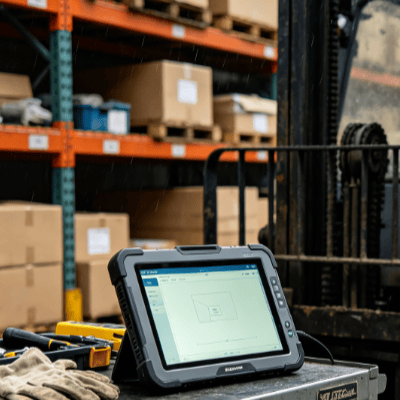
In the demanding environments of modern manufacturing, logistics, and field services, a standard consumer-grade tablet is a liability. For engineers and project managers, the reliability of hardware often hinges on a single technical specification: the IP rating.
An IP rating for industrial tablet devices is more than a marketing label; it is a standardized measure of a device’s ability to withstand environmental stressors that would otherwise lead to immediate hardware failure or long-term circuit corrosion.
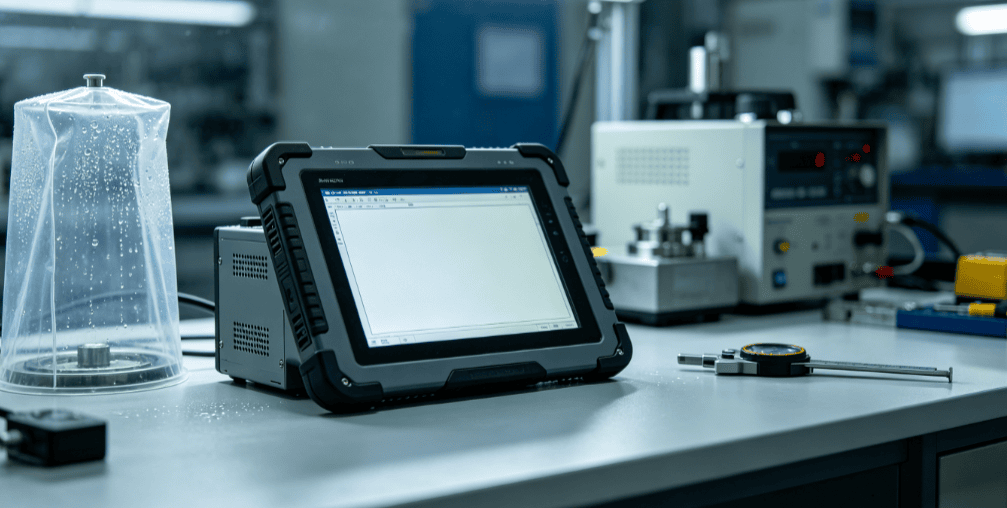
What is an IP Rating? Understanding the IEC 60529 Standard
The Ingress Protection (IP) rating system is defined by the International Electrotechnical Commission (IEC) under standard 60529. It provides a transparent framework for classifying the degrees of protection provided by electrical equipment enclosures.
Unlike vague terms like “waterproof” or “dust-resistant,” an IP rating provides specific technical data regarding two types of ingress: solid particles and liquids. The rating is always expressed as “IP” followed by two digits.
- The First Digit (0–6): Represents protection against solid foreign objects (dust, grit, accidental contact).
- The Second Digit (0–9K): Represents protection against various forms of moisture (drips, sprays, high-pressure jets, immersion).
Decoding the Numerical Hierarchy
For an industrial tablet to be considered “rugged,” it typically begins at the IP54 level, but most industrial applications require higher thresholds.
First Digit: Solid Particle Protection
In industrial automation or woodworking facilities, fine dust can penetrate narrow seams, coating internal heat sinks and causing thermal throttling or short circuits.
| Level | Protection Against | Description for Industrial Use |
| 5 | Dust Protected | Ingress of dust is not entirely prevented, but it must not enter in sufficient quantity to interfere with operation. |
| 6 | Dust Tight | No ingress of dust; complete protection against contact. Essential for mining and milling. |
Second Digit: Liquid Ingress Protection
From condensation in cold storage to high-pressure washdowns in food processing, liquid protection is critical.
| Level | Protection From | Practical Application |
| 5 | Water Jets | Protection against low-pressure water streams from any angle. |
| 7 | Immersion (up to 1m) | Device can survive accidental drops into puddles or shallow tanks for 30 minutes. |
| 8 | Continuous Immersion | Designed for underwater use or extreme outdoor flooding conditions. |
IP65 vs. IP67: Choosing the Right Protection Level
When evaluating hardware from specialized providers like Industrial-TabletPC, procurement teams often choose between IP65 and IP67. The distinction is subtle but carries significant operational implications.
IP65: The Factory Floor Standard
An IP65-rated industrial tablet is “dust-tight” and protected against water projected from a nozzle. This is generally sufficient for indoor manufacturing environments where the device might be wiped down or exposed to occasional splashes but will never be submerged.
IP67: The Field Service Standard
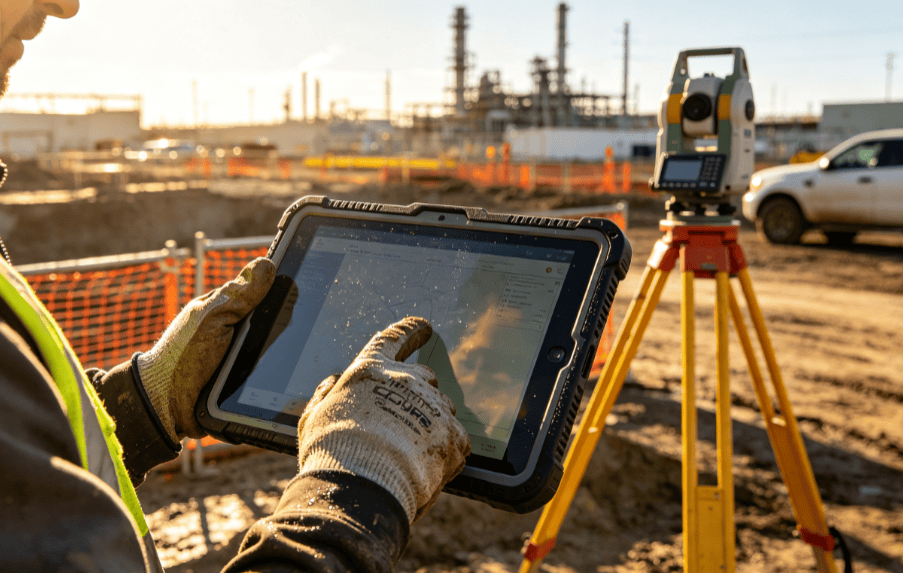
For outdoor utilities, construction sites, or oil and gas exploration, IP67 is the baseline. These tablets can withstand heavy rain and total immersion in water. The sealing mechanisms in IP67 devices are often more robust, utilizing specialized gaskets and chemically bonded glass to ensure vacuum-tight integrity.
Beyond IP Ratings: The Role of Rugged Engineering
While the IP rating for industrial tablet devices covers ingress, it does not account for kinetic shock or vibration. In a true industrial ecosystem, IP ratings should work in tandem with MIL-STD-810G standards.
Industrial-grade tablets are engineered with reinforced chassis and shock-mounted internal components. This ensures that while the IP sealing keeps the moisture out, the internal architecture survives the vibration of a forklift or a 1.2-meter drop onto concrete.
We observe that in high-volume logistics, the failure rate of IP65 tablets is significantly lower than consumer devices because the industrial sealing prevents the gradual “breathing” of humid air into the device, which typically causes micro-corrosion over 18–24 months.
Environmental Suitability by Industry
Selecting the correct IP rating requires a deep understanding of the specific operational “micro-climate.”
- Warehousing & Logistics: Typically requires IP54 to IP65. The primary concern is dust from cardboard and vibration from vehicles.
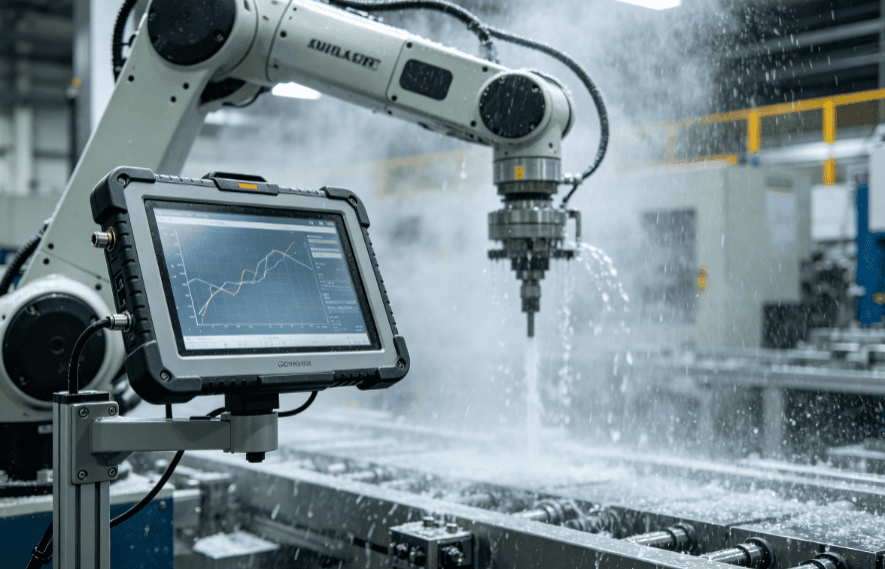
- Food & Beverage Processing: Often requires IP67 or even IP69K. Devices must withstand high-heat, high-pressure sanitization sprays.
- Chemical & Pharmaceutical: Requires IP65 with specialized chemical-resistant housing materials to prevent the degradation of the seals themselves.
- Marine & Offshore: Requires IP67/IP68 and salt-fog resistance. Saltwater is highly conductive and corrosive; even a microscopic breach in the seal can be fatal to the PCB.
Critical Design Considerations for Industrial Seals
When reviewing technical specifications, pay attention to how the IP rating is achieved. High-quality industrial tablets often feature:
- I/O Port Covers: Heavy-duty rubberized or hinged doors with internal gaskets.
- Pressure Equalization Vents: These allow the device to “breathe” during temperature shifts without allowing moisture ingress, preventing seal fatigue.
- Bonded Displays: Eliminating the air gap between the touch layer and the LCD prevents internal condensation.
FAQ
Q: Is an IP68 tablet always better than an IP65 tablet?
A: Not necessarily. While IP68 offers higher protection against immersion, it may involve permanent seals that make the device harder to service or more expensive. If your environment only involves dust and light spray, an IP65 tablet is often the more cost-effective and practical choice.
Q: Can I use an IP67 industrial tablet in a high-pressure washdown environment?
A: Technically, no. IP67 is rated for immersion, not high-pressure water jets. For washdown environments (common in food processing), you should look for an IP69K rating, which specifically tests for high-pressure and high-temperature water.
Q: Do IP ratings cover protection against chemicals or oils?
A: No. IP ratings specifically test for water (H2O). If your tablet will be exposed to cutting oils, hydraulic fluids, or cleaning chemicals, you must check the material compatibility of the tablet’s outer casing and seals, regardless of the IP rating.
Q: Does the IP rating change over the life of the tablet?
A: Yes. Ingress protection can degrade due to seal wear, exposure to extreme UV (sunlight), or repeated drops that slightly warp the chassis. Regular inspection of port covers and gaskets is recommended for devices used in critical environments.
Reference Sources
- IEC 60529: Degrees of protection provided by enclosures .
- ISO 20653: Road vehicles — Degrees of protection .
- National Electrical Manufacturers Association (NEMA): Enclosure types and environmental testing.
- MIL-STD-810G/H: Department of Defense Test Method Standard for Environmental Engineering Considerations.